Subtitle: Six choruses for mixed choir, to poems by Anna Akhmatova and Rimma Dalos, in Russian
Dedication: No. 2 to Mrs. Zina Brájer, No. 4 to Sonia [Sofia] Gubaidulina
Premiere location: London
Premiere date: 1981.02.03.
Premiere performers: BBC Singers, conducted by: John Poole
Lyricist name: Anna Akhmatova, Rimma Dalos
Language: Russian
Composition end date: 1981
Genre: Choruses
Instrumentation: mixed choir
Duration (minutes): 10
Year of publication: 1980
Publisher: Editio Musica Budapest
Publication number: Z. 12037 – ISMN M-080-12037-8
1. Склонение местоимения “чей”
2. Разрыв (отрывок)
3. Любовь на месяц …
4. Но как узнать мне … – Канон
5. О, назидание – любовь!
6. И отверста для меня …
________
1. Declension of the pronoun “whose”
2. The break
3. Love for a month...
4. But how do I know... – Canon
5. O love, the edifier!
6. And the door is open for me...
1. Склонение местоимения “чей”
Чей, чья, чьё, чьи, чьего, чьих, чью, чьей,
Чъему, чьим, чьими,о чьём,о чьей, о чъих.
2. Анна Ахматова: Разрыв (отрывок)
Не недели, месяцы - годы
Расставались. И вот, наконец
Холодок настоящей свободы
И седой над висками венец.
3. Римма Далош: Любовь на месяц …
(Посвящение Тристану)
Любовь на месяц,
Страдание на годы,
Вот и прошло всё.
4. Римма Далош: Но как узнать мне … – Канон (Кор. 1. 7. 16)
Но как узнать мне
Спасу ли я тебя,
Спасешь ли ты меня?
5. Римма Далош: О, назидание – любовь! (Кор. 1. 8. 1)
O, назидание – любовь!
Дано ты всем
И всеми позабыто...
6. Римма Далош: И отверста для меня … (Кор. 1. 16. 9.)
И отверста для меня
Дверь великая и широкая!
Да не смею чрез неё пройти ...
________
1. Declension of the pronoun “whose”
(Mikhail Lermontov: “...and life, if you look around with a cool gaze, is such an empty and silly joke...”)
Whose, whose, whose…
2. Anna Akhmatova: The break (excerpt)
Not weeks, not months – years
We have been parting. And at last
The chill of real freedom
And a wreath of grey above the temples.
3. Rimma Dalos: Love for a month ...
(Hommage à Tristan)
Love for a month,
Suffering for years,
And so everything is past.
4. Rimma Dalos: But how do I know ... – Canon
(after Corinthians 7.16)
But how do I know
that I shall save you
or that you will save me?
5. Rimma Dalos: O love, the edifier!
(after Corinthians 8.1)
O love, the edifier!
You are given to everyone
and forgotten by all ...
6. Rimma Dalos: And the door is open for me ...
(after Corinthians 16.9)
... and the great, wide door
is open for me.
And I dare not pass through it ...
(Translated by Geoffrey Norris)
Composed in 1979, Omaggio a Luigi Nono (Op. 16) consists of six short a cappella movements. The Italian title and the dedication to Nono are merely the outer shell of the piece. Created at the urging of the Italian composer, this choral work was set to a Russian text and fits squarely among Kurtág’s Russian-inspired compositions: it is a peculiar sister piece to the Troussova-cycle, which was taking shape at that time. Its conceptual world continues partly in Troussova and in subsequent Russian-language song cycles, deepening the theme toward the individual, the subjective self, and lyrical subjectivity, and partly in the Russian choral works he began composing as early as 1980. These choral works open out toward Songs of Despair and Sorrow (Op. 18) in which the questions raised in Omaggio are ultimately answered in this later major work. The motto of the first movement of Omaggio (“…and life, if you look around with a cool gaze, is such an empty and silly joke…”) is the closing line of the Lermontov poem, which would later become the text of the first movement of Songs of Despair and Sorrow. The second movement of Omaggio is based on a poem by Akhmatova, one that is quite different and more subjective in nature than the Akhmatova poem set to music in the large choral works. The text of its final movement is taken from Rimma Dalos’s cycle titled The Writings of the Apostle Paul Addressed to Me: “And the great, wide door / is open for me. / And I dare not pass through it” (Translation by Geoffrey Norris) Humanity’s hesitation, doubt, fear of the transcendent, and dread of death are expressed in the music of the movement’s middle section, in a single extended measure whose solo voices foreshadow Magdalene’s sobbing in the fifth movement of the later choruses. In the music, at the beginning and end of the final movement of Omaggio, stands the gate that the individual dares not enter, and in the fifth movement of the later choral works, the mother – whom no one dares to look at – also stands there; she stands there in the music. The great question – the question of death – which remains open at the end of Omaggio finds its answer and is resolved in the silence of the ritual concluding the other Russian choral cycle, Songs of Despair and Sorrow.
(Excerpt from Márta Papp’s essay György Kurtág’s “Russian Choirs”; Holmi 18 [2006]/6, 736.)
No sheet music files available for this piece.
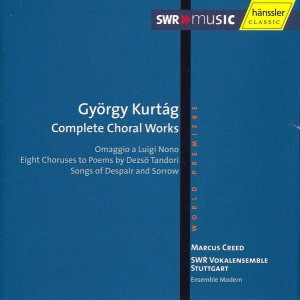
No sheet music files available for this piece.