„If he plays a single note C, even that holds everything in it”
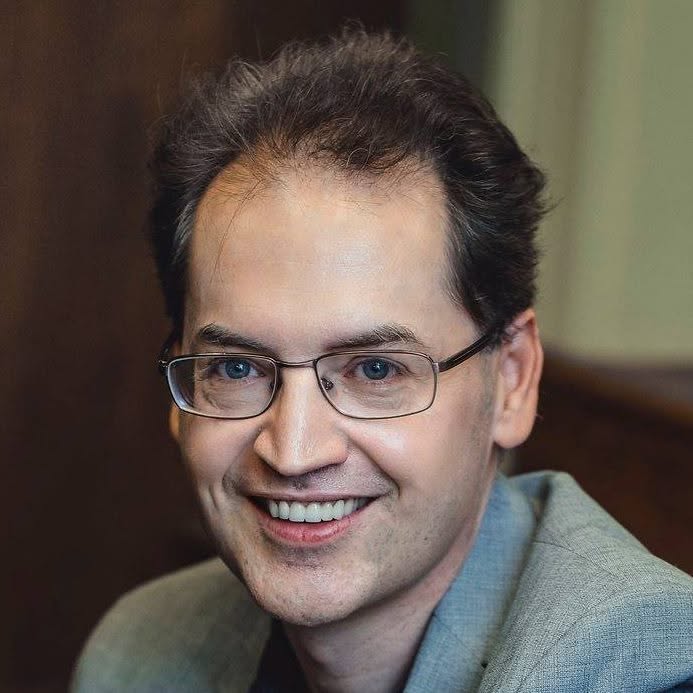
Pianist Dénes Várjon about György Kurtág. Interview by Máté Csabai.
There has never been an easy way for György Kurtág: he could work on a single bar for hours, and he wanted to find the whole world behind a single note. Dénes Várjon studied with him for 10 years, and he still carries Kurtág’s gestures, images, and unrelenting standards in himself. We talked about the centenarian master, Márta Kurtág, and a musical heritage lasting for a lifetime.
You were fifteen years old when you first got in touch with György Kurtág, still as a student at the School for Exceptional Young Talents. How did this meeting take place?
I remember it like a strange dream. Erika Tóth, a fantastic young violinist a couple of years my senior and more experienced than me at the time, was looking for a fellow musician to play chamber music with, and she came to one of my concerts. Erika studied with both Sándor Devich and Kurtág at the same time, and, since she liked how I played at that evening – a sonata by Mozart –, she asked me to play with her. At first, I didn’t know it meant we would also study with Uncle Gyuri, which wasn’t easy to arrange by the way, let alone as a student of the School. On a Saturday morning, at 8 o’clock sharp, we started to work on the Spring Sonata. I was a green boy with little experience in chamber music, but Kurtág was very kind to me immediately, and he worked with us with that incorruptible standard that only he had. In the first one and a half hours, we worked on the first eight bars, but it opened my eyes to so many things and gave me so much insight that I never felt lost. At that time, I hadn’t known his pieces, I only found his music later, in other situations. But, I had already played to Ferenc Rados and Albert Simon, and I had a taste of Kurtág’s method right in the first lesson. To this day, I still remember a moment in the Spring Sonata, a gesture of sixteenth notes before the piano takes over the theme, which he showed in a glissando-like fashion: he pointed out how many different ways it could be played, how this transition could become a single gesture, how the sonority changes if I use the pedal in a different way.
Did he turn to a fifteen-years-old adolescent differently than to an adult?
I only know that he was very kind. When we sometimes would feel discouraged, he responded to that very sensitively, too. I clearly remember a lesson when he asked of Erika, “Why are you so sad?”. She replied, “Because I can’t do it.” To which Uncle Gyuri said, “Well, do not want to do it.” Then he added that, the entire previous week, he felt he could teach in Weiner’s spirit, and now even he was struggling with the piece.
So he would show that he himself struggled with the problems he taught?
Yes. He never considered his own instructions infallible, though his every word still seemed to be revelation. He wouldn’t pronounce absolute truths – he himself was seeking and searching. I had already read interviews with him, and I saw that he wasn’t a composer who would pour out works easily, he rather brought them to life through great suffering. He would often recall Thomas Mann’s short story, Schwere Stunde (lit. a heavy/hard hour – the transl.), which precisely captures the kind of creative mental state which is so characteristic of him: Schiller feels blocked, has to struggle with his material, and, in the meantime, he envies Goethe who seems to have everything much easier. In this story, there is another idea, which is very much like Kurtág: talent is a heavy burden, and art is born through great inner fight. Kurtág took it for granted that there is no easy way. When I played his piece Hommage à R. Sch. for the first time – we might have played it a hundred and fifty times since then –, he wrote to me, “To Dénes. Do not rest.” And, also: it isn’t enough if something is played correctly, you must perish in the process. I feel Beethoven and Bartók are the same as him in this.
Has there been anyone who could not keep up with this work ethic?
Surely. Even though it wasn’t shadowboxing. Uncle Gyuri was happy even if a single spark lit up, and if something was successful, he said, “Now, you’ve learned something from yourself.” He didn’t pass on ready-made teaching, he rather led you to discover many things. The lessons were incredibly intensive emotionally, we were looking for the very essence of every bar, every gesture. He also had a great sense of humour.
Did you study with him later, too?
Regularly for ten years, and we met at masterclasses even after that. I remember one time at the international seminaire in Prussia Cove. We played Brahms with brilliant musicians, I was much older, and, I believe, he really liked it. I saw him truly relaxed, he was inspired by the sea, the special company of musicians, the presence of Sándor Végh, the Takács Quartet, the others.
It is not often said that Kurtág can be enthusiastic. He still goes to concerts at the age of one hundred – not only to those where his works are being performed.
I have seen this side of him. He was enthusiastic about Sándor Végh, and he sat through all his rehearsals with the score in hand in Prussia Cove, where Végh was working on the Great Fugue with the orchestra formed from his students. At the end of the day, Kurtág said the last time he had felt like that was when he had seen Michelangelo’s statues for the first time. But he was also enthusiastic about Annie Fischer, he would often say that Annie “can almost smell the notes.” However much one strives to get close to the essence of the works, the most beautiful moments are given as gift, then they can pass, and one must fight for them again. He often said so while teaching, too.
What was his personal connection with his students like?
Very good, though – contrary to Ferenc Rados, to whom we turned to with all sorts of problems, emotional, professional, career questions – it was always about music with Uncle Gyuri, everything came up through music. He would enter, we would shake hands, and we started playing right away. I studied regularly with him for ten years, but he knew little about my private life. Of course, he knew about Iza – my wife, the pianist Izabella Simon, who has also studied with him –, but we generally didn’t talk about such things. Still, we could get very close to him through music.
Can you remember a phrase or a piece of advice he said that is still with you to this day?
Many, many things. I still play a lot of pieces that I studied with him, and these lessons are so strongly alive in me as if they had been yesterday. I played Mozart’s Sonata in F major, in which there is a section:
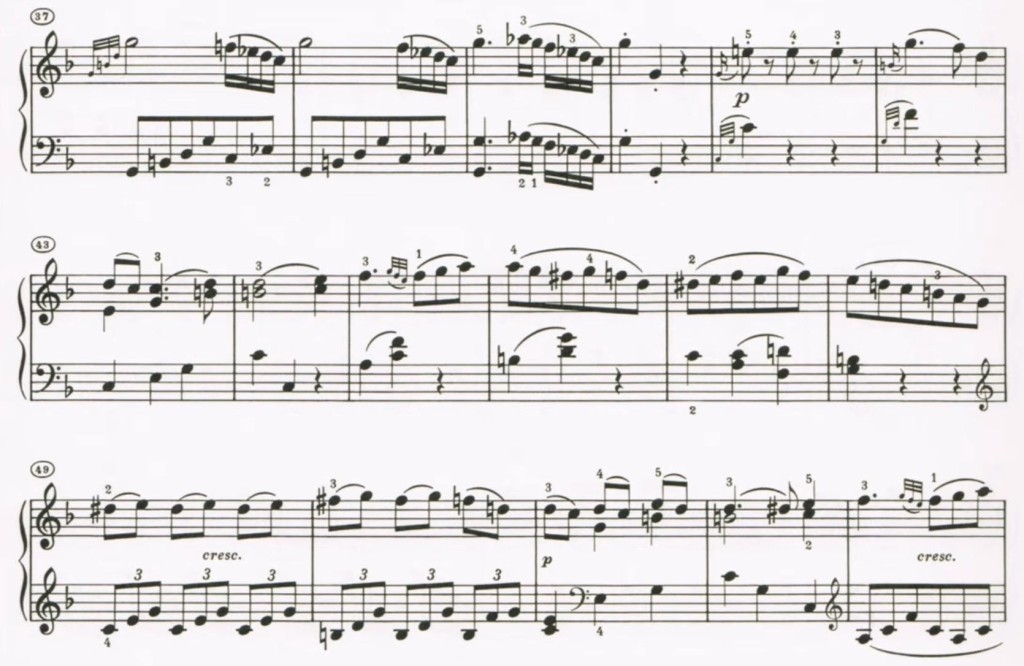
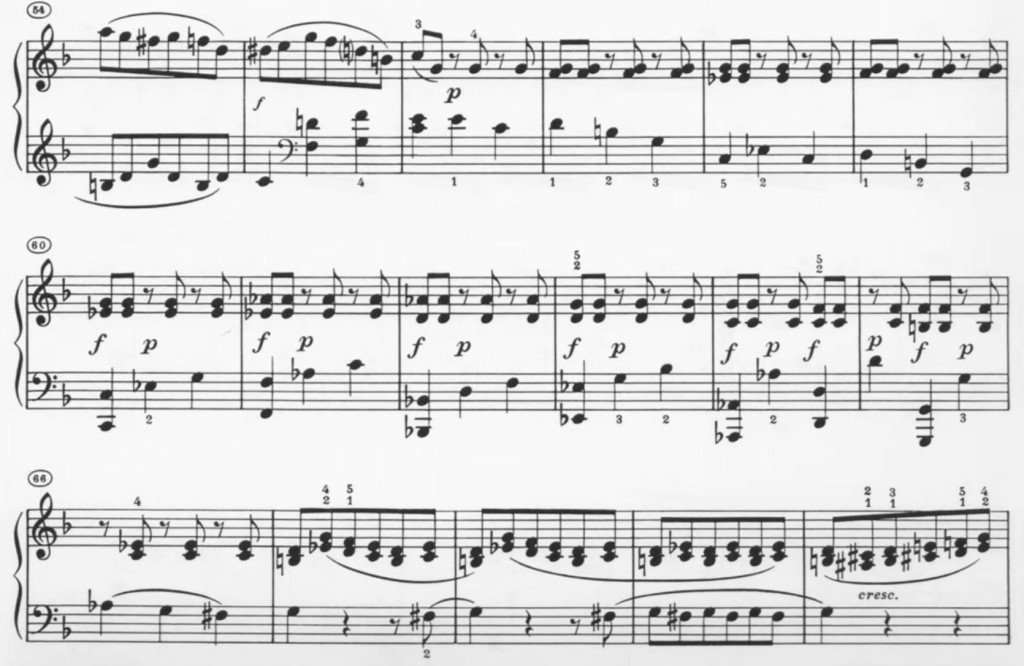
After the second part of the second theme, when a motif in the major key turns into the minor key and forte and piano alternate measure by measure after that, the idyllic atmosphere turns dramatic. I tried to play it this way and that way, but it was never enough for him. Then he said, “It is like an opera. The Marriage of Figaro.” I was to imagine that Marcellina loves Figaro, and sees Susanna as a competitor, and then, unexpectedly, it turns out that Figaro is, actually, her son. When Marcellina notices the sign, the special birthmark, she recognises him, and says, “Come here, son, I am your mother.” We are first in major, then, suddenly, in minor, because they are also scared of the recognition. And then Uncle Gyuri sang, “His mother, his mother, his mother, his mother.” It showed immediately how the relationship between the notes changes in a sonata by Mozart, how perfect idyll turns into a storm, a scandal, a conflict. In one moment, someone is still chuckling under their nose, in the next one, they are falling into despair. To this day, I cannot play this section without thinking about these ideas. Kurtág is aided by his enormous musical knowledge as well as his imagination.
I once played Brahms’s first Intermezzo from Op. 118, which begins like this:
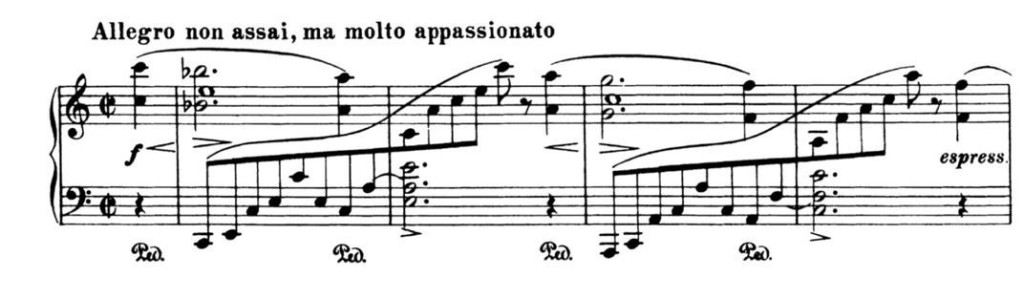
The exclamation at the beginning wasn’t expressive enough for him. So, he said, “Here, Tristane cries, «Isolde, Isolde».” We worked for two and a half hours on that one-and-a-half-minutes piece. There is a cadence-like passage then the close at the end:
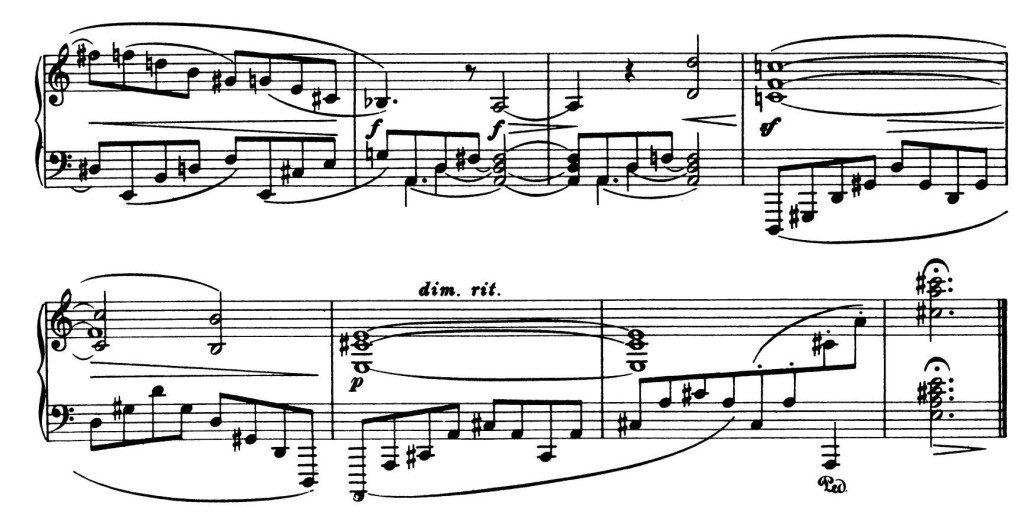
He asked me to play the end as Christ cries out one last time on the cross before dying. In such a short Brahms piece, we arrived from Isolde to Christ’s immolation, and there was nothing forced about it; on the contrary, he illuminated the ideas behind the 19th-century musical work. In Schumann’s Symphonic Etudes, he explained that the amazing variation in g sharp minor before the finale sounds like the noises in the night, the sounds of the forest, in which a lonely voice, Isolde’s, calls Tristane to herself from the darkness.
It is quite interesting that he would turn to opera to understand absolute music.
I owe it to him that I love Verdi’s operas this much. He would often say that, besides Bach’s passions and Mozart’s operas, Verdi’s music was also formative experience for him. And if he mentioned something we didn’t know, we were terribly ashamed; he simply said, “You don’t know it? It’s essential. Get to know it.” He brought tapes, all sorts of recordings, which he thought were important for us to hear. But he also spoke about Thomas Mann, Tolstoy, Attila József. These literary inspirations also show up in his works.
Why was his method of working on a fairly short piece for days so effective?
The goal wasn’t to end up with a clean, polished performance, we were rather looking for the truths of the gestures and the inner nature of musical events; of course, with the barely achievable demand to truly realise them. He often used the expression “internal earthquake”, and he had another phrase which inspired me a great deal: “surplus force”. That something must be played with a commanding presence, not struggling, just as the gods cast lightening form the sky not through infinite effort, but effortlessly, just by willing it. There is such power that does not have to prove itself. This idea came up in Mozart’s Sonata for violin and piano in E flat major, at the beginning of the development:
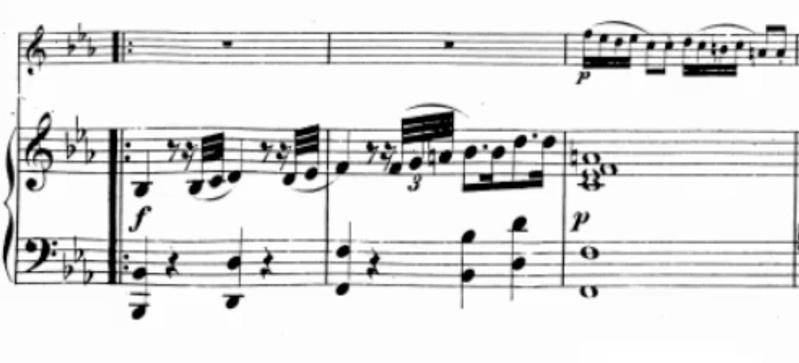
He also had an example for this from an opera: the scene from Figaro when Cherubino is locked up, because he was changing in the Countess’s chambers, and the jealous Count enters the stage and demands the key. He does not merely ask questions, he issues a command, too, “Where? Where is the key?” This is surplus force. No struggle, no fight, just ordering them: “give it to me”.
And what does “internal earthquake” mean?
He used this phrase for certain sforzati or strange harmonies. He always warned that the important thing is not simply being loud, but the inner power of the given section. That the given note or chord has some inner tension. For example, in Schumann’s Fantasia in C major, there is a chord about which he said, “It should be played like when we would press the stone out of a cherry as children.” These images might seem strange at first, but one understood right away what he meant because there was imagination, playfulness, and shared experience in them. The title of the cycle Games is no accident, either; playing with the world and the things in it is inseparable from how Kurtág thinks about music.
But I also learned technical solutions from him. It often happened that, if something didn’t work out, we transposed it to the highest register, where it’s easier to play. This method still works for me. If there was a difficult unisono passage, we practised by crossing the two hands: the left hand was on top so that the weaker hand would take the lead, and, this way, the right hand quasi taught a new solution to the left hand.
What have you kept as a teacher?
Kurtág’s teachings are so much alive in me, they have become a part of me to such an extent that it’s not at all easy for me to answer this question. For him, it wasn’t only the result that mattered, but so did the approach and the way of achieving it. One could learn from Kurtág that there is no easy way, and the truth is somewhere between the practice room and the concert hall. It was actually criticism if he said, “This was a concert.”
What did it mean?
I can only guess, but something like this: the concert is done now, come, let’s start anew tomorrow.
Which one of Kurtág’s works did you get familiar with first?
It was he who handed me five movements from Games, and I still play them to this day. I played them to him a couple of years ago, and I also performed them at Wigmore Hall in July. The …quasi una fantasia… and his Double concerto have also been very important for me, and so has his trio.
It is known about Béla Bartók that, however excellent a pianist he was, he did not have any students who would become truly significant performers. On the contrary, countless students of Kurtág have become real performing artists. What may have been the secret behind this?
I have never felt my own personality at risk with Kurtág. Actually, he once also said to me, “Dénes, a mannerism is a mannerism even if it’s a Kurtág mannerism.” In effect, the secret is that, as his students, we could closely observe how Kurtág got in touch with the pieces, how he formed a relationship to them, and, through this, we also saw the processes a performer had to go through. Of course, we would sometimes struggle heavily. In the first movement of Splinters, I wrestled a lot with the hard, ringing, “splintery” touch to resemble a dulcimer.
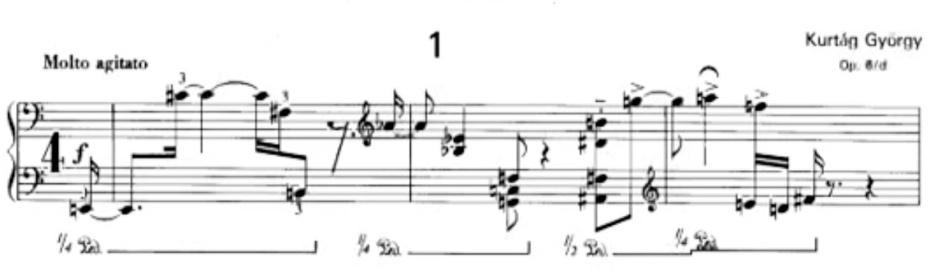
A couple of years later, I said to Uncle Gyuri that I would play the piece. He replied, “Ugh, I remember, it didn’t go well at all.” But then, when I went to see them and play them the piece, Aunt Márta looked at him and said, “Bad luck.” I asked why. She said, “Because this is good.” These encounters always recharged and inspired me. Of course, I know not everyone could tolerate that Kurtág would take what they were playing apart to pieces. I wouldn’t say it’s never been awkward when he came to listen to a concert of mine. Yet, his presence rather turned me up to a higher intensity.
What was your relationship with Márta Kurtág?
Very good. When I started to study with Uncle Gyuri, I hadn’t met Aunt Márta yet, but, later, it would happen sometimes when they were ill that they received me at home. They were sitting there in their dressing gowns, and yet, they worked with us for four hours with the same inexhaustible attention.
You play four-hands a lot with Izabella Simon, your wife. Was the example of the Kurtágs an inspiration for this?
Yes. What the two of them created with these pieces is an example and an ideal. We also play these transcriptions of Bach’s pieces a lot, but we haven’t played to him with Iza yet. But we will do so soon.
What did you feel in the way they played together? What did the two of them have together?
Their whole life. And this is typical of Kurtág’s music anyway: if he plays a single note C, even that holds everything. There is the totality of life, the struggles, the doubts, the entire inner story. This is what was felt when they played together, too. It wasn’t simply two people making music: their entire shared life was present.
What would you say, did Márta give up her own career as a pianist to become György Kurtág’s partner?
Márta was a complete personality. One of the greatest performances of her life is, indeed, her fantastic recording of the Diabelli Variations. But she herself said about the recording that she always used the plural when it came to music, because she had worked together with her husband her whole life. It was, indeed, a real question and real pain in her life: where she herself was. But she was a true partner to Uncle Gyuri, no one was closer to him in spirit.
When did you notice that your master, György Kurtág was considered a legend abroad, too?
We were his students exactly at the time when the world opened to him. When I started studying with him around 1985, he wasn’t yet widely known abroad; the premiere of Messages of the Late Miss R. V. Trussova by Pierre Boulez, then the Kurtág-portrait at the Salzburg Festival in 1993 made his music known by the whole world. Suddenly, the greatest artists commissioned works from him, and there were great premieres at the most important concert halls, yet, he gave up not a single iota of his standards and his methods, from the way he liked to work. He hasn’t adapted to success and it hasn’t changed him. The same inner relentlessness of his has remained.
What do you think is the significance of Kurtág’s music?
In Kurtág’s music, there is Bach, Mozart, Beethoven, Schumann, Brahms, and Bartók, a deep familiarity with the works of the past. Not through quotes, references, or style studies, but as a part of his own inner world. He created his own language – and, indeed, his own notation, too, since no one else writes like Kurtág – in such a way that everything is organically rooted in the past and in the ancestors. And, to all this, countless personal details are connected: his life’s experience, his unparalleled sensitivity, and a certain kind of “movement culture”, too. I know it’s weird to use this phrase, but they often said to me with Márta that I should watch pantomime and gain inspiration from it, because music is also a pantomime-like system of gestures, it has a body, it has movement, directions, tension.
As a performer or teacher, have you had to explain Kurtág’s music?
When teaching, yes, a lot.
How flexible is he himself about his own works?
Very much. I think there is no such thing as a final draft by Kurtág. Iza once went to see him with Péter Bársony and Gábor Varga to work on his piece Hommage à R. Sch. They played the third movement, “…und wieder zuckt es schmerzlich F. um die Lippen…”, in which Florestan’s mouth flinches painfully (this, of course, refers to Schumann’s cycle Davidsbündlertänze). There is a junction in the piece when the three players start together, and Iza remarked jokingly, “Uncle Gyuri, it would be so much better or at least easier if there was a note before it.” To which Uncle Gyuri immediately said, “Give me a pencil.” Iza protested to no effect that she had only been joking, he insisted, “No, no, let’s try it!” He took the score, entered the note, and said, “This is how it is from now on.”
What does Kurtág’s music mean to you?
Knowing him and having some sort of connection to him helps a lot in understanding his music. I’m not saying that this is the only way, but Kurtág’s way of thinking is difficult to separate from his works. He would often say that he was “teaching his last will and testament”. He passes on something from his own approach to music to everyone he works with, he passes on something that is impossible to register in a score. When he says, for example, “Now do an enormous crescendo, but in such a way that you become gradually softer in the meantime” – this may sound a paradox first, but it does have an exact meaning. Or, when he says that the softer one says something, the greater the intensity can be. To whisper at the top of one’s lungs. He was talking about a piece once – I don’t recall which one –, in which a tam-tam was struck. The volume grew and grew with every repetition, and, right when the loudest strike should have come, nothing was heard. And, still, that was the loudest one. For Kurtág, the essential thing isn’t the material aspect of music. Its intensity is often the strongest precisely in the space where there are no more notes. At the same time, his music is often quite simple, it strives for simplicity. He has extremely complex works, for example the Double concerto, in which the players are sat apart, each solo instrument has its own orchestra behind it, several layers are heard at once, each has its own life, and plenty of rehearsals are necessary for the production to come together. Yet, appreciating it isn’t difficult at all, because it has an elementary effect. Kurtág often has to be understood through the body, not the intellect. He once said that he would sometimes feel the size and greatness of a building in his body. This is also how his music can be felt.
Finally, I wanted to ask about his well-known brevity, may it be the cycle Games or other works. His piano pieces are often one or two minutes long, sometimes even shorter. What is the task to play them like?
In such a performance, there can be no idle time or a single thoughtless note. Kurtág sometimes says as much in a fifty-second piece as Mahler does in a whole symphony. There is an entire life behind every gesture. They are not so much miniatures rather than condensed universes. Kurtág often composed these pieces as a message or homage. If someone died, he didn’t send a condolence card, he asked someone instead to play the piece. He also said, “I leave signs. And if these signs matter to you, do something with them. If not, then forget them.”