Dedication: Ferenc Sulyok
Premiere location: Budapest, Chamber Hall of the National Philharmony
Premiere date: 1963.11.17.
Premiere performers: Budapest Wind Quintet: Zoltán Jeney (flute); Tibor Szeszler (oboe); Ferenc Meizl (clarinet); János Ónozó (horn); László Hara (bassoon)
Composition end location: Budapest
Composition end date: 1959.08
Genre: Chamber Music
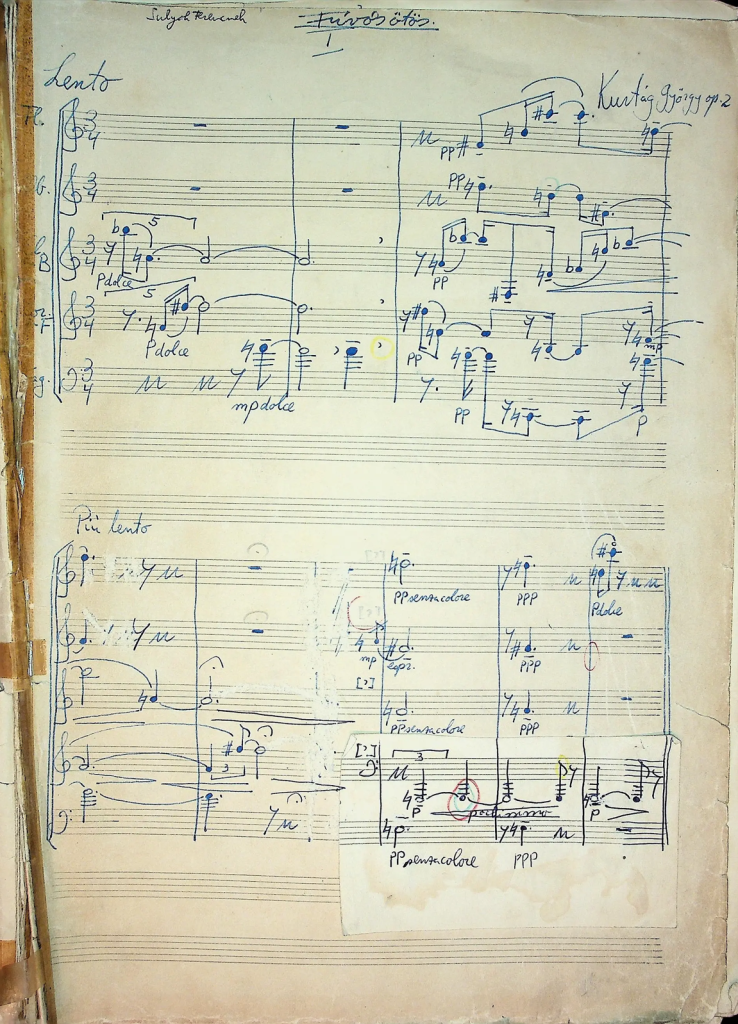
Instrumentation: flute, oboe, clarinet, horn, bassoon
Duration (minutes): 7
Year of publication: 1964
Publisher: Editio Musica Budapest
Publication number: Z. 14638
1. Lento
2. Agitato
3. Vivo
4. Molto sostenuto
5. Rubato, improvvisando
6. Grave, ma con slancio
7. Mesto
8. Rubato, molto agitato
It is an instrumental work with no text.
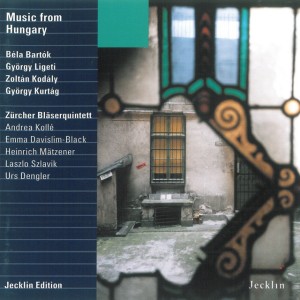
The composition, as Kurtág recalled during the discussion, was written in fulfilment of a vow he had made in Paris in 1958. At the time, he was experiencing a profound creative crisis. After the suppression of the 1956 Hungarian Revolution, he left Hungary in 1957 and moved to the French capital, where he studied with Olivier Messiaen and Darius Milhaud. Yet he was unhappy and tormented by doubts. In this period of searching, he was aided by the art psychologist Marianne Stein and by his former Academy classmate Ferenc Sulyok, who was also living in Paris. Sulyok—who had emigrated as early as 1948 and was by then using the name Franz—was indeed one of Kurtág’s closest friends. During their Academy years, he sang bass in a quartet alongside György Ligeti and the Kurtág couple; the group frequently gathered to make music together for pleasure in their spare time. When, in the summer of 1958, Kurtág decided to return to Hungary after completing his studies and to create a new musical language in his works, he promised Sulyok that he would write two compositions: a string quartet (which became the emblematic Op. 1) and a wind quintet. The genre was popular in Hungarian composition during the 1950s and 1960s: György Ligeti had already written a piece in 1953, based on folk material and featuring classical elements, and by 1968 he had composed ten movements for this ensemble in a modern Western style. In addition to Kurtág and Ligeti, numerous composers wrote for this ensemble, including Zsolt Durkó (Improvisations, 1964), Emil Petrovics (Wind Quintet, 1965), and Rudolf Maros (Consort, 1970).
No sheet music files available for this piece.
Reviews of the world premiere
Review by István Raics
(Film Színház Muzsika, November 22, 1963)
[…] György Kurtág, who follows his own path, has developed his wind quintet, comprising eight short movements, into a cycle brimming with drama and intense expression. Powerful emotions follow one another in vivid, image-like flashes, and the melodic world is effectively replaced here by an alternation of timbres and combinations, while the structure remains perceptible in the intensely heightened tension of contrasts. The excellent performers fully captured the work’s novelty. […]
(„Zenei esték: A Budapesti Fúvósötös bemutatói”, Film Színház Muzsika 5 (1961)/17, 14.)
_________________
Review by András Pernye
(Magyar Nemzet, November 23, 1963)
[…] The highlight of the evening was György Kurtág’s Wind Quintet, Op. 2, composed in 1959. Kurtág’s music only seems complicated at first glance; in reality, it is quite simple. This simplicity lies above all in the fact that Kurtág is not bound to any particular musical technique or compositional method; thus, in this respect, he creates the maximum possible freedom for his message to unfold. Freed from technical constraints, he can devote his attention to communication without limitations. A certain asceticism shows itself, above all, in the way he shapes his works: he sets very narrow limits for himself and his message, allowing no superfluous notes or empty sections of form, yet he cannot be accused of letting his self-restraint degenerate into self-mutilation.
This aspect of Kurtág’s development as a composer stems from the fact that, after his early, traditionally styled works (the Korean Cantata, the Viola Concerto), his compositional practice took a sharp turn. He evidently felt that he had to dismantle his previous method and begin again, relying solely on the most essential elements.
The Wind Quintet appears to be one such foundational work, particularly because fundamental moods and emotions find expressive form here. Melancholic, painful, plaintive, and ironic movements follow one another – brief moods and sonic images. Some begin with a jarring impact but soon resolve into clear triads; others shape order and a solid line out of the initial chaos. Each movement reveals a new, tiny world, making us curious about the next. Kurtág’s work had to be repeated this time.
Special praise is due to the Budapest Wind Quintet, whose dedicated, careful, and conscientious work ensured the evening’s consistently high standard. It has been a long time since we’ve heard such enthusiastic and excellent music making from a Hungarian chamber ensemble.
(„Egy hét Budapest hangversenytermeiben”, Magyar Nemzet 19 (1963)/274, 4.)
_________________
Review by János Breuer (Népszabadság, November 30, 1963)
[…] One of the new works from Hungary was György Kurtág’s Quintet for Wind Instruments. Its eight miniature movements are like snapshots of the world. Kurtág knows the great secret of expressing powerful emotions in small, aphoristic forms with extremely few means. The high-tension emotional charge is the essential feature that distinguishes this work from that of yet another charlatan of the musical avant-garde, one who parades around with world-changing slogans. Kurtág organizes these new – and therefore unusual – means of expression with extraordinary compositional skill, yet the diverse musical traditions of our century continue to live on in each of his sounds and melodic turns. This wind quintet is an exceptionally polished piece of compositional work; there is not a single superfluous note, not a single unnecessary or replaceable effect – even the improvisational elements fit organically into the work’s overall structure – hence the music’s great concentration and evocative power. […]
The concert hall was nearly filled to capacity for the Budapest Wind Quintet’s concert of modern music. Hopefully, this interest and success will also draw the attention of other prestigious ensembles to the fact that programming contemporary music is no longer as risky for performers as it was 8–10 years ago; indeed, it is increasingly a venture that promises success.
(„A Budapesti Fúvósötös bemutató hangversenye”, Népszabadság 21 (1963)/280, 8.)
_________________
János Breuer’s review (Muzsika, January 1964)
[…] György Kurtág’s Wind Quintet (1959) was the most significant premiere of the evening. Its brief, aphoristic movements impress with their extraordinary expressive intensity. This music was composed in the spirit of modern compositional principles, yet it is also deeply rooted in tradition. Most importantly, the composer conveys human emotions; his music is not technical display or avant-garde posturing designed to attract attention, but a jarring, unsettling – and yet soothing – experience. It is astonishing what Kurtág can convey in just a few seconds with a single interval. Tension and release – the fundamental principle of musical form – are evident in the relationship between the movements. The most strictly structured musical material finds its resolution in playfully improvised passages. Kurtág’s music has such a profound effect on his listeners because he strives, with genuine conviction and without compromise, to portray the entirety of the world as he knows it. The work was the concert’s greatest success, and the audience’s unceasing applause prompted an encore of the entire wind quintet. […]
(„A Budapesti Fúvósötös bemutató estje”, Muzsika 7 (1964)/1, 10–11.)

No sheet music files available for this piece.