Dedication: Marianne Stein
Premiere location: Budapest, Chamber Hall of the National Philharmony
Premiere date: 1961.04.24.
Premiere performers: Várkonyi Quartet: István Várkonyi, Vera Kármán (violin); Gyula Kisszékelyi (viola); Ottó Kertész (violoncello)
Composition end location: Budapest
Composition end date: 1959.04.24
Genre: Chamber Music
Instrumentation: 2 violins, viola, violoncello
Duration (minutes): 14
Year of publication: 1961
Publisher: Editio Musica Budapest
Publication number: Pocket score: Z. 40128 – ISMN: M-080-40128-8; parts: Z. 4482 – ISMN: M-080-04482-7
1 Poco agitato
2 Con moto
3 Vivacissimo
4 Con spirito
5 Molto ostinato
6 Adagio
It is an instrumental work with no text.
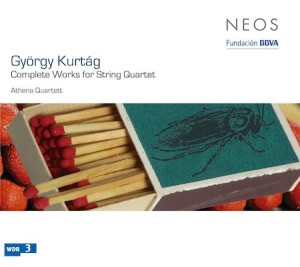
This six-movement work, composed after a year in Paris following the 1956 Revolution, is the first piece in Kurtág’s official catalogue, as indicated by its opus number. His study trip to Paris prompted Kurtág to reinterpret his musical thinking. Leaving Bartók’s musical idiom behind, he employs the postwar avant-garde system of gestures in his own distinctive way in this work. Kurtág recalled the piece as follows: “Interestingly enough, it so happened that I gave programs to the first movement in some of my later works as well. That was the case with my String Quartet, Op. 1. I’m not sure whether I attributed a program to the work retrospectively or was already conscious of it during the composition process. I was living in Paris, in a crisis that made it impossible for me to compose: in 1956, the world had literally collapsed around me—not just the external world but my inner world too. Numerous moral questions had also arisen in relation to the work I was doing with Marianne Stein; my entire conduct as a human being had become highly questionable. I sank to terrible depths of despair. Previously I had shunted responsibility for many things onto others, but now, all at once, I was obliged to recognize that I had become disillusioned with my own self, my own character. […] The experience of trees in winter was perhaps the first reality. That carried on almost until spring, when birds appeared as a second reality. Only later did I establish that the blackbird was the “fundamental bird,” but the argumentative chattering of sparrows makes an appearance in the quartet’s fourth movement, the ‘bird scherzo’. […] The next stage of that was my starting to make angular forms from matches. A whole symbolic world evolved. I perceived myself as in a worm-like state, totally diminished in humanity. The matchstick forms and balls of dust (I didn’t clean my room every day), along with black stubs (I also smoked) represented me. I gave this matchstick composition the title ‘The cockroach seeks a way to the
light’ (I stuck a lamp shape made from silver foil at the end of the composition). That was also supposed to become the program for the string quartet’s first movement. The overtone chord symbolized the light, and in between the dirt. I almost inscribed as an epigraph at the start of the movement two lines by
Tudor Arghezi: ‘From mildew, suppurating wounds and ordure / I generated new beauties and
values.’” [Bálint András Varga (ed.), György Kurtág: Three interviews and Ligeti homages (Rochester: University of Rochester Press, 2009), 6–7.]
No sheet music files available for this piece.
Reviews of the world premiere
Mihály Meixner’s review
(Film Színház Muzsika, 28 April 1961)
Our outstanding composer, Ferenc Farkas, has been engaged in pedagogical work for twenty-five years. To mark this anniversary, his best students organised a concert of his works at the Chamber Hall [of the Liszt Academy]. Each of these students is now a well-known composer and a promising talent among the young generation of Hungarian composers. The success of the works by Miklós Kocsár, Sándor Szokolay, György Kurtág, Lajos Vass, and Emil Petrovics not only praises the original, individual talent of these five composers but also highlights the highly significant work that Ferenc Farkas has done in nurturing this new generation of composers.
Due to space constraints, we can only briefly describe the compositions presented, among which György Kurtág’s string quartet made the greatest impression (in a first-rate performance by the Várkonyi Quartet). Kurtág composed his work – conceived in the spirit of the latest stylistic endeavours – by deploying the full arsenal of string quartet technique, with a wealth of dazzling ideas and the use of startling timbres. Alongside this outstanding technical mastery, the composition’s fragmentation and formal ambiguities were barely noticeable.
(Film Színház Muzsika 5 (1961)/17, 22–23.)
_______________
János Breuer’s review
(Muzsika, July 1961)
[…] The concert featured a programme item that was eagerly anticipated and sparked no less intense debate: the premiere performance of György Kurtág’s string quartet, presented by the Várkonyi String Quartet (members: István Várkonyi, Vera Kármán, Gyula Kisszékely, Ottó Kertész). György Kurtág used to regard Bartók as his greatest ideal (as evidenced by his earlier works). More recently, without Bartók’s influence having diminished, Anton Webern and his followers have also strongly influenced his creative work. The music we heard is an experiment, a bold attempt, but undoubtedly a successful and effective, captivating experiment. Its rhythmic world condenses the motions of Bartók’s String Quartets Nos. 3 and 4, Music, and the Sonata for Two Pianos; it is a derivative of the rhythm world of these works. Its melodies, however – though they make scant use of dodecaphony – were conceived in the spirit of Webern’s economy of expression. This economy of expression and the motto-like character run through the String Quartet, and as I listened to its energy unleashed with elemental force and its peculiar colours, I thought that alongside traditional, slowly burning energy sources, the tension inherent in the atom today releases far greater power in a fraction of a second. Even after listening to it many times, I could not say whether György Kurtág’s String Quartet is beautiful music. I am convinced, however, that both the circles of supporters who championed it and those who rigidly rejected it contributed to the premiere becoming a treat and a sensation. One major question, however, remained unanswered: where is György Kurtág’s path leading? […]
(Muzsika 4 (1961)/7, 35–36.)
No sheet music files available for this piece.