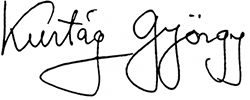
Recollections of the teaching of György Kurtág and Ferenc Rados
How did you come into contact with György Kurtág? When did you work together, when did he teach you?
In 1968 I was admitted to the Academy of Music, into Pál Kadosa’s class. For a Preparatory Course, as I was roo young — and too immature as well. Kurtág was Kadosa’s assistant at the time. He then passed this position over to Ferenc Rados. Later I attended his chamber music classes, but I also often played piano pieces for him. So all this happened at the Academy of Music, for nearly a whole decade.
What does György Kurtág’s art and teaching mean to you and how has it influenced your career and thinking?
His impact has been, is and always will be crucial. I know no other musician who cherishes music so much. And this happens to be „contagious”. To learn that every note has importance, that no note should be sounded irresponsibly. It’s a sort of environmental protection in a musical sense. To respect the piece and the composer, to understand and to follow the score.
If you can, please recall a memorable situation and how he taught certain musical works and what you learned from him during your collaboration!
I could list countless examples, but that would take really long. My very first piano class was due in room VIII. I took Bach’s three part invention in E major. After two hours I couldn’t get further than about the forth bar. Kurtág had important things to say about each note. I was aghast how much I didn’t know about Bach, nor about the piano. Kurtág showed me everything on the secondary piano — a horrendous one by the Estonia brand. He played it so magnificently that one completely forgot he imperfection of the instrument. Zoli Kocsis was playing the Prelude and Fugue in B minor after me. I found it impressive. A prolonged silence ensued when he finished. Then Kurtág softly said ”Ugly. ”
”The piece or the way I play it?” asked Zoli flabbergasted.
”The way you play it.”
About Mozart’s sonatas Kurtág constantly came up with operatic analogies: ”This is like Donna Anna, this is Don Ottavio, this one is Figaro or the Abduction.” At the age of 14 I did have some ideas about Mozart’s operas, but not enough. Consequently we immediately rushed over to the library and borrowed all the sheet music to overcome the shortcomings. Kurtág gave us Schubert for homework, the two Suleika songs plus Der Zwerg. We had to both sing and play the piano, we were taking turns with Zoli. Kurtág was incredibly inspiring, he introduced us to the parallels between poetry and music. He had a general air of such comprehensive culture that went far beyond the limits of conventional piano education.
Do you have a characteristic, memorable, instructive or funny story about your joint work that you would like to share?
These are implied in the previous examples. Just one more thing: throughout these early years we hardly even knew that Kurtág himself was a composer. His inconceiavable humbleness all but prevented him from ever mentioning it. Zoltán Kocsis knew of course, he was even familiar with all his works. Years later, when I was learning The Sayings of Peter Bornemisza with him, with grueling labour, he told me: “See, this is my revenge on pianists for not becoming a pianist myself.”
How did you come into contact with Ferenc Rados? When did you work together, when did he teach you?
Around 1969-1970, in the Academy of Music, for something like eight years.
What does Ferenc Rados’ pedagogical mentality mean to you and how has it influenced your career?
He was my most important teacher, along with Kurtág. Maybe even more so than Kurtág. Because Kurtág expected unachievable things of me, due to my lack of instrumental proficiency. While Rados could teach me even this, but additionally in such a way that always made sense musically.
The piano is, of course, a half mechanical instrument. It has enourmous capacities, but there are lots of things it’s incapable of. Such as a perfect play of legato, or holding out a long sustained single note. The art is in making the listener believe in the illusionary presence of these deficiencies. All this can only be achieved if one listens to himself in the right way, as if with a third ear. Techniqe thus doesn’t mean that somebody can play fast, loud and flawlessly — that is the mere mechanics. Techniqe is a much higher category, it is an alloy of vivid concept and adequate execution. And Rados was able to teach all of this brilliantly, and to display it as well. Sound production and the versatility of the player’s touch is very rarely talked about nowadays. Which is such a pity, as the piano is not a percussion instrument, is it?
I am also indebted to Rados for teaching me to practice the right way. Preferably for fewer hours but with absolute attention, focused, listening to myself. Often with reduced speed or volume, but always paying attantion to the quality of the sound, and thinking in musical phrases and paragraphs. One can save a great deal of time this way. It is terribly exhausting to practice for 8-10 hours each day, and superfluous as well. To practice for 3-4 hours in a sposhisticated and disciplined way can be worth so much more. Increased physical exertion might result in tendonitis and other serious injuries. Fate has spared me from all such things, thanks to Rados.
If you can, please recall a memorable situation and how he taught certain musical works and what you learned from him during your collaboration!
I cannot choose specific examples about him. It was rather that whatever I brought to him, he could instantly screen the whole of the piece like an X-ray machine. For the Moscow Tchaikovsky Competition of 1974 everyone had to learn a new Soviet piece. The Scherzo by Pirumov, it was an awful piece. Well, Rados took this nothing and made an outstanding work of it, just like an alchemist would. Pirumov could hardly believe his ears upon hearing it.
Do you have a characteristic, memorable, instructive or funny story about your joint work that you would like to share?
“Weeell, as it were…” This is how he started every single one of his sentences. We had to learn to speak in Rados to understand his mindset. Deep in the labyrinth of his metaphors. By the way, this was only getting more and more complicated as time passed: the irony, sarcasm and cynicism. But I think it was merely a mask to hide his true humanity and warmth, which he didn’t want to own up to. He was not sentimental and wouldn’t stand human nonsense. And he was right.