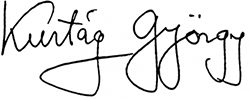
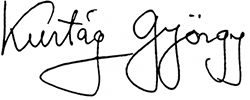
GYÖRGY KURTÁG, Hungarian composer, pianist, and chamber music teacher.
He was born on February 19, 1926, in Lugoj, Banat, Romania. He became a Hungarian citizen in 1948 and acquired French citizenship in 2002. In 1931, at age five, he began learning to play the piano. In Timișoara, he studied piano with Magda Kardos, a pupil of Bartók, and composition with Max Eisikovits.
In 1945, he auditioned for the Liszt Academy of Music in Budapest, where he studied three disciplines from 1946 to 1953: composition with Sándor Veress and later Ferenc Farkas, piano with Pál Kadosa, and chamber music with Leó Weiner. In 1947, he married pianist Márta Kinsker. Their son, composer György Kurtág Jr., was born in 1954. At the Academy of Music, he formed a lifelong friendship with György Ligeti.
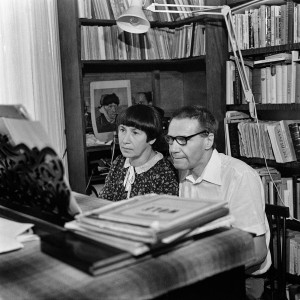 Among his compositions from the early 1950s are works that met the expectations of the communist party: mass songs, piano pieces, songs, and choral works. Two major compositions from this period stand out: the Korean Cantata (1953, withdrawn), for which he received the Erkel Prize, and the Viola Concerto, premiered in 1955, which follows Bartók’s late style (its second movement is withdrawn). After the 1956 revolution, he planned to emigrate; he ultimately spent a year in Paris starting in the spring of 1957, but his wife and son were refused passports, so he returned home in the spring of 1958. In Paris, he attended courses by Olivier Messiaen and Darius Milhaud, became acquainted with the work of Anton Webern and Samuel Beckett, but the greatest influence on him was the art psychologist Marianne Stein, who gave a new direction to his artistic development.
After returning from Paris, he composed the String Quartet (Op. 1), which marked the start of his official body of work. From 1960 to 1967, he worked as a répétiteur for the soloists of the National Philharmonic concert organization. In 1967, he began teaching at the Academy of Music, first as an assistant to Pál Kadosa in the piano department, and later as a chamber music instructor. He left the institution in 1986 but continued to return regularly to teach until 1993. Since the 1990s, he has held master classes worldwide and continues to teach.
Until the mid-1960s, he composed cycles of chamber music and instrumental solos consisting of extremely short movements, along with a few occasional commissions for theater and film music. Between 1963 and 1968, he wrote the nearly 45-minute cycle The Sayings of Péter Bornemisza (Op. 7) for soprano and piano, the first vocal work in his official catalog. After two more vocal cycles (In Memory of a Winter Sunset, Op. 8; Four Capriccios, Op. 9), he experienced a creative crisis in the early 1970s. In 1971, as a DAAD fellow, he spent a year in West Berlin, where he planned an orchestral series titled 24 Antiphonae (Op. 10), dedicated to György Ligeti, but did not complete it.
In 1973, he was awarded the Kossuth Prize, which further intensified his creative paralysis (he received the award again in 1996 and the Kossuth Grand Prize in 2026). Around the same time, piano teacher Marianne Teőke asked him to write piano pieces for beginners. This request helped him overcome his crisis and led to the creation of the Játékok (Games) series, which continues to grow. The first four volumes were published simultaneously in 1979, and the most recent, the 11th volume, was published in 2026. The first four volumes of Games follow pedagogical principles, while the later ones serve more as Kurtág’s personal musical diary entries or a field for compositional experimentation. By the mid-1970s, he had completed two additional vocal cycles: Four Songs to poems by János Pilinszky (Op. 11) and S. K. Remembrance Noise (Op. 12), the latter set to texts by Dezső Tandori. The second half of the decade is marked by vocal compositions in Russian, including the piece for chamber ensemble and soprano, Messages of the Late Miss R. V. Troussova (Op. 17). The premiere, held in Paris in 1981, brought international recognition to Kurtág, who until then had lived in isolation behind the Iron Curtain, although he was considered one of Hungary’s most significant composers. The most influential piece of the 1980s and the most frequently recorded work by Kurtág is Kafka-Fragmente (Op. 24), composed for soprano solo and violin, dedicated to Marianne Stein, and premiered in Germany by Adrienne Csengery and András Keller. During this period, the Russian-language choral work Songs of Despair and Sorrow (Op. 18) was also composed, though it did not reach its final form until the mid-1990s. Kurtág described it as “my Missa solemnis.”
By the end of the 1980s, Kurtág had become a leading figure in the international contemporary music scene, receiving an increasing number of awards and commissions. Around this time, he began writing for large orchestra, though not in the traditional manner, but for solo instrument(s) and groups of instruments positioned throughout the space. One such work is …quasi una fantasia… (Op. 27, No. 1), commissioned by the Berlin Festival Weeks in 1987–1988 (pianist Zoltán Kocsis performed the solo at the Berlin premiere, conducted by Péter Eötvös), and the Double Concerto (Op. 27, No. 2), premiered in Frankfurt in 1990 with the participation of the two most significant European contemporary music ensembles, Ensemble Modern and Ensemble Intercontemporain (with pianist Zoltán Kocsis and cellist Miklós Perényi as soloists, conducted by Péter Eötvös). Grabstein für Stephan (Op. 15c) from 1989, which features solo guitar, also belongs to this group of compositions. Several chamber works also took their final form at the very end of the 1980s, including Hommage à R. Sch. (Op. 15d) and the string quartet Officium breve in memoriam Andrae Szervánszky (Op. 28). The former pays homage to Schumann, while the latter honors the memory of Endre Szervánszky and Anton Webern. Around this time, Kurtág also composed his first setting of a Beckett text, What is the Word (Op. 30a), for the singer Ildikó Monyók, who was struggling with aphasia. A version of this work, expanded to include a vocal ensemble and chamber orchestra (Op. 30b), was premiered in Vienna in 1991 under the baton of Claudio Abbado.
In 1993, at the invitation of the Wissenschaftskolleg in Berlin, Kurtág moved to the German capital for two years as composer-in-residence with the Berlin Philharmonic, for whom he composed Stele, Op. 33, his first piece written for a traditional symphony orchestra. In 1995–1996, Kurtág was a guest of the Vienna Konzerthaus in a similar capacity, followed by Amsterdam (1996–1998), Berlin again (1998–1999), and Paris (1999–2001). The 1990s largely brought a series of orchestral movements adapted from the piano pieces of Games and from other previously composed pieces (Messages, Op. 34; New Messages, Op. 34a), as well as new song cycles. These include the Hölderlin-Gesänge (Op. 35), written for solo baritone and still expanding today; …pas à pas… (Op. 36), which sets Beckett aphorisms to music using a bass singer, string trio, and percussionist; and Einige Sätze aus den Sudelbüchern Georg Christoph Lichtenbergs (Op. 37), composed for soprano and double bass.
Between 2001 and 2015, the Kurtág couple lived in the town of St. André de Cubzac near Bordeaux, after which they moved back to Budapest in 2015, settling in a guest apartment at the Budapest Music Center, where Kurtág currently lives and works (Márta passed away in 2019). During the first decade of the new millennium, significant works in the genres of song cycle, symphonic music, solo instrumental music, and oratorio emerged from Kurtág’s studio. Four Poems by Anna Akhmatova (Op. 41) was in development for years and was finally premiered at Carnegie Hall in 2009, with soprano Natalia Zagorinskaya as soloist and the UMZE Chamber Ensemble conducted by Péter Eötvös. The violin-viola double concerto dedicated to Hiromi Kikuchi and Ken Hakii, …concertante… (Op. 42), was written in 2003. The longest solo instrumental piece in his oeuvre, Hipartita for violin (Op. 43), took its final form in 2007. In 2009, Colindă – Baladă (Op. 46), a work for tenor solo, choir, and orchestra that draws on Kurtág’s Romanian roots, was premiered in Cluj-Napoca.
Although Kurtág had planned to compose an opera since the 1950s, he did not begin work on his first opera, Fin de partie – based on Beckett’s play, which he first encountered in Paris in 1957 – until 2010. The nearly two-hour work premiered in 2018 at La Scala in Milan, conducted by Markus Stenz, and reviews appeared in all major media outlets worldwide. The premiere of his second opera, the one-act monodrama Die Stechardin, with a libretto by Christoph Heinz, took place in 2026.
György Kurtág’s awards and honors:
Ferenc Erkel Prize (1954, 1956, 1969)
Kossuth Prize (1973, 1996, 2026)
Distinguished Artist (1980)
Bartók–Pásztory Prize (1984)
Officer of the French Order of Arts and Letters (1985)
Composer’s Prize of the Prince Peter of Monaco Foundation for his works Grabstein für Stephan, Op. 15c and Double Concerto, Op. 27, No. 2 (1993)
Herder Prize (1993)
The Freiherr-vom-Stein Stiftung Prize, Hamburg (1993)
Feltrinelli Prize from the Accademia Nazionale dei Lincei in Rome (1993)
Austrian State Prize for European Composers (1994)
Grand Music Prize of the Ernst von Siemens Foundation (1994)
Denis de Rougemont Prize from the European Festivals Association (1994)
Austria’s “Österreichisches Ehrenzeichen” Award (1998)
Medal of Merit for Science and the Arts in Berlin (1999)
Grants to Artists Award in New York (2000)
Hölderlin Prize from the University of Tübingen (2001)
Middle Cross of the Order of Merit of the Republic of Hungary with Star (2001)
Honorary Citizen of Budapest (2001)
Homeland Award (2002)
Lifetime Achievement Award titled “Classique 2006 Special Award” at the 40th MIDEM (Cannes) (2006)
Grand Cross of the Order of Merit of the Republic of Hungary (2006)
Gold Medal of the British Royal Philharmonic Society (2013)
BBVA Foundation “Frontiers of Knowledge” Award in the contemporary music category (2014)
Franco Buitoni Special Prize (2017)
Artisjus Award: “Classical Music Work of the Year” for the opera *Fin de partie* (2019)
Rolf Schock Prize (2020)
Honorary Citizen of Ferencváros (2020)
Wolf Prize (2024)
Honorary Member of the Accademia Nazionale di Santa Cecilia
Honorary Doctorate from the Liszt Ferenc Academy of Music (2026)
Gold Medal of the Gloria Artis Medal of Cultural Merit from the Polish government (2026)
Since 2024, the asteroid 550942 Kurtág(wd) has been named after him.