Subtitle: To fragments from 1929–37 by Attila József, for soprano solo, in Hungarian
Premiere location: Budapest
Premiere date: 1982.10.27.
Premiere performers: Adrienne Csengery
Lyricist name: Attila József
Language: Hungarian
Composition end date: 1982
Genre: Solo voice
Instrumentation: soprano
Duration (minutes): 15
Year of publication: 1984
Publisher: Editio Musica Budapest
Publication number: Z. 12304 – ISMN: M-080-12304-1
1. The water thickens, swelling into ice
2. Many came and pressed around me (Shadow play)
3. For seven – I ask myself
4. Time sprouts one the run, like beans
5. The poet's love is blazing straw
6. Amazed am I (Hommage à Bakki József)
7. Tell me, what should I do to make you love me
8. The sweet breeze purls along
9. Girls' knees stalk our predatory eyes
10 For fifteen years I've been writing verse
11. The evening is soft as a grape
12. And amazed I am
13. Help me, all of you, not to kill her
14. I'm stranger and alone (Perpetuum mobile)
15. There'll be tender meet with young kholrabi
16. No! no! I ought to cry
17. The heat looms above the garden
18. Mercy, mother, mama
19. The water thickens, swelling into ice
20. Song, lean out of my lips
1. The water thickens, swelling into ice
The water thickens, swelling into ice,
and my sins gather into death.
2. Many came and pressed around me
Many came and pressed around me
in my dreams they laughed and mocked me:
Ha-ha-ha, he-he-he, So he is the one with the treasure
that's nothing!'
3. For seven – I ask myself
For seven – I ask myself –
will you give six, pray?
I'm playing. The merit is
his who was able to play.
4. Time sprouts on the run, like beans
Time sprouts on the run, like beans.
5. The poet's love is blazing straw
The poet's love is blazing straw,
hence its greed and devouring speed.
6. Amazed am I
Amazed am I
that I shall die.
7. Tell me, what should I do to make you love me
Tell me, what should I do to make you love me,
if I should weep, don't laugh or mock me -
Like a car with engine racing
but there's no road, no way of starting, –that's me,
and were I bolder
my words would lack all sense or order ...
8. The sweet breeze purls along
The sweet breeze purls along
among the poplars, silver-foamed,
and the gigantic summer
just bathes in it, golden-limbed.
9. Girls' knees stalk our predatory eyes
Girls' knees stalk our predatory eyes
and in my fury I could kill a fairy,
though for this leaky, foundling life
it isn't – I admit – worth killing.
10. For fifteen years I've been writing verse
For fifteen years I've been writing verse
and now, when I might at last become a poet,
I just stand here by the ironworks
and have no words for the moonlit sky.
11. The evening is as soft as a grape
The evening is as soft as a grape.
rolling gently among my memories.
A blond evening. But I can't remember…
12. And amazed I am
And amazed am I
that I shall die.
13. Help me, all of you, not to kill her
Help me, all of you, not to kill her,
not to expunge her suddenly
from among the world's images.
14. I'm a stranger and alone
I'm a stranger and alone, my words are floating mold.
bright and heavy am I, like the cold.
15. There'll be tender meat with young kohlrabi
There'll be tender meat with young kohlrabi,
the ox grows fat and the green maize swells,
but all this grows from our dust now.
16. No! no! I ought to cry
No! no! I ought to cry.
yet I whisper: yes, yes,
so that fate might bring a gentle rocking
to the waters of a sea of tears.
17. The heat looms above the garden
The heat looms above the garden,
an idol conjuring a never heard Void;
with its wrinkled little hand the branch grasps
a spider's web and waves, resigned.
A fine dust fuzzes the puddle.
18. Mercy, mother, mama
Mercy, mother, mama, look, oh woe,
this poem too is done!
19. The water thickens, swelling into ice
The water thickens, swelling into ice,
and my sins gather into death.
20. Song lean out of my lips
Song lean out of my lips
and sorrow, don't reach me until tomorrow.
I must bow down still further
to be able to sing without knowing anything.
(Translated by Peter Sherwood)
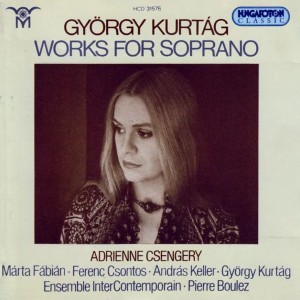
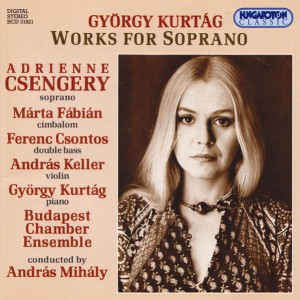
Kurtág’s ascetic compositional approach – the principle of “saying as much as possible with as few means as possible” – is most powerfully evident in the cycle Attila József Fragments (Op. 20), composed and premiered in 1982. Written for unaccompanied voice – specifically for the soprano Adrienne Csengery, who sang at the premiere – the work simultaneously evokes the worlds of Gregorian chant, 17th-century monody, Hungarian folk song, and 20th-century vocal music. This is Kurtág’s first piece written for solo voice, but not his last; the Hölderlin-Gesänge (Op. 35a) and Fancsikó és Pinta (Op. 40), set to texts by Péter Esterházy, also belong to this genre. For the Attila József Fragments, Kurtág did not take “fragments” from finished poems but instead selected a few-line poetic sketches that the poet had left as fragments from the outset. Kurtág transforms the powerful, realistic images and human situations characteristic of Attila József into strikingly intense musical images, sketching the atmosphere of contemplation, despair, weariness, happiness, and fear of death with just a few notes. The work premiered on October 26, 1982, in Budapest.
No sheet music files available for this piece.
Reviews of the World Premiere
Review by György Kroó
(The New Hungarian Quarterly, 1983)
[…] But the real event of this festival was the concert at which works were heard from two members of the 50-year-old generation. László Kalmár’s title Readings (1981) indicates that these pieces, beautifully scored and fully exploiting the historical and technical possibilities in linear polyphony, are merely notations in principle of a musical conception: for a real presentation by flesh-and-blood musicians they have to be worked out each time. For this concert the composer gave four of the fourteen readings the colours of the flute, the clarinet, the bassoon, the horn, the trumpet, the trombone, the cello, the double bass, and the piano; by inserting variation movements he turned the four pieces into a six-movement cycle. This performance demonstrated the piece’s architecture; it also showed us the appealing, shy lyricism of the composer and his artistry of expression.
The second part of the concert was devoted to the confessional world of György Kurtág. The twenty song miniatures written for poetic fragments of Attila József were sung twice by Adrienne Csengery, to whom the cycle was dedicated. Between the two performances the composer and his wife alternately or together played fifteen miniatures on the piano – laments, capriccios, and pieces of hommage, extracts from the fifth volume of Games now at press. Kurtág does not consider this work, intended originally for teaching purposes but, like Bartók’s Mikrokosmos, developed into a compositional album, as closed. The two performances of the songs this time were a repetition making possible a more precise and better understanding and at the same time a display of two versions of the work. The significance of the cycle in Kurtág’s oeuvre is threefold. Primarily, it documents his first encounter with a major poet who has exerted the greatest influence on present-day Hungarian poetry. Secondly, it was written for a single solo voice, without any accompaniment whatever. After seven hundred years of European polyphony, to return – even if temporarily – to monody is a significant undertaking and speaks of the presence of a melodic invention par excellence. The enchantment of this new monody to the Hungarian ear consists in the fact that it takes the individual, subjective tone of the Lied to that communal medium which for centuries had carried the Hungarian peasant song and the Gregorian chant. The third noteworthy feature of the cycle is that, in the case of most songs, it offers possible variants on the basic versions, and more than once verse settings composed in two different ways – alternatives between the adorned or the plain, the embellished or the simple; in fact, there is even a song which gives the performer the possibility of several kinds of combinations of these four basic versions. To these should be added the variants of expression, the extreme possibilities of which are recommended by the composer. The songs, with one exception, are settings to music of the complete poetic text of the Attila József fragments. The principal attraction for Kurtág was obviously an aphoristic poetic formulation of a feeling or a thought, and a text that in only two instances extends to four short lines; after all, he has always been a composer of miniatures. All of the songs date from between May and October 1981. For me the setting of the words „The water turns mushy, the ice forms and our sins congeal as death” revealed most hauntingly Kurtág’s drive to the tragic in the soul. Familiar was the tone, the frightening laughter of „They were many and surrounded me”, his diabolic scherzo, of his virtuoso capriccios, the coloraturas of „Time yields on the run”, the ease, lightness of touch, and the freedom of shape in the echoes of „For seven – I ask myself – do you give six”, and the jigsaw pattern of „I am amazed, that I expire.” Kurtág’s most individual voice is heard in the „I have nothing to do with anyone”, the welding of the slow csárdás with the perpetuum mobile character, in the song There will be soft flesh, where the folksong-like, plainsong-like beginning is gradually mistuned, or in the contrast between the colourless non-legatos versus the pianissimo legatissimos of the song entitled My Garden. However, if I endeavour to survey this major work, which Adrienne Csengery gave a totally committed interpretation of, then I must emphasize two facts. One is this unmistakable, triumphant rebirth of melody – but not neo-romanticism – in new music, and the other concerns Kurtág as a composer who seems to possess now a brilliant oeuvre, and one which deserves an important place in today’s music. The Attila József song cycle added to this world not so much to its breadth, but to its depth and intensity.
A festival of contemporary music can surely not do more than present us a work of this quality.
(„Music of Our Age Festival, 1982”, The New Hungarian Quarterly 24 [1983]/90, 206–209.)
______
Review by Sándor Kovács
(Muzsika, January 1983)
[…] The next concert quickly eclipses the memory of what came before. The first half – a performance of László Kalmár’s chamber work Olvasmányok (Readings)—does not yet leave a lasting impression; the piece feels dry and stilted, and I believe it falls far short of the composer’s best work. The second part, however, a new Kurtág premiere, as so often in recent years, was once again a true celebration of music. As for Töredékek (Fragments, Op. 20), set to verses by Attila József, I confess that I don’t even know what to make of it. Kurtág virtually knocks the pen out of the critic’s hand: it is hardly worth – or even permissible – to write about a creative achievement of this caliber within the usual scope and vocabulary of music criticism.
The richness of expression – noble and free of pathos – that Kurtág achieves with a single vocal part is breathtaking. For me, one movement perhaps stands out from the rest: the eighteenth, beginning with “Mercy, mother, mama, look, oh woe…”; here, I feel the tragedy of Attila József’s words is so elusive that no music seems to fit them at all. But then again, this is just one movement out of twenty. As for the rest, there’s only one word for them: masterpieces. Masterpieces, in fact, much to the chagrin of structural analysts – it doesn’t matter at all which version you hear. What makes this concert interesting is that we hear the song cycle in two different ways: the second time, we hear the composers’ and performers’ versions of a few movements. Equivalent versions. What makes them all equally good? Perhaps that is the question that can bring us closer to the true, essential secrets of the work. If I were a composer, I would certainly be seeking the answer to this question, as well as to the question of what makes Kurtág’s four-hand transcriptions of the Schütz choral works – performed between the two versions of the song cycle as part of the new releases in the Games series – so magnificent. What makes the solo piano piece Voice from Afar – which also appears later in the concert in another version – so astonishing? Its material is, after all, not particularly complicated: a series of minor ninths starting on F-sharp, accompanied by a peculiar, folk-song-like melody.
There is a movement in Bartók’s For Children series that – though this is a matter of subjective, personal judgment – is particularly close to my heart. It is the penultimate piece in the final volume, in which Bartók created a kind of quiet lament from a Slovak melody that originally had playful, even obscene lyrics. I rarely listen to it – usually I don’t dare to – because it grips me so intensely. I’m not claiming that Kurtág’s piece has any particular resemblance to it. I don’t think I’ll dare to listen to the Kurtág piece very often either. Just one more sentence about the concert: the performers – Adrienne Csengery, Márta Kurtág, and György Kurtág – did exactly what they were supposed to do, and in this age of verbal inflation, a critic has nothing more to add to that simple statement of fact. […]
(„Korunk zenéje ’82”, Muzsika 26 [1983]/1, 19–26.)
No sheet music files available for this piece.