Subtitle: Fifteen songs to poems by Rimma Dalos, for soprano, violin, double bass and cimbalom, in Russian
Dedication: Adrienne Csengery
Premiere location: Budapest
Premiere date: 1983.10.05.
Premiere performers: Adrienne Csengery (soprano); András Keller (violin); Ferenc Csontos (double bass); Márta Fábián (cimbalom)
Lyricist name: Rimma Dalos
Language: Russian
Composition end date: 1982
Genre: Chamber Music with Voice
Instrumentation: soprano, violin, double bass, cimbalom
Duration (minutes): 19
Year of publication: 1985
Publisher: Universal Edition/Editio Musica Budapest
Publication number: Z. 12661
1. Приди
2. От встречи до расставания
3. Мольба
4. Позволь мне
5. Считалочка
6. Сон
7. Рондо
8. Нагота
9. Вальс для шарманки
10. Сказка
11. Снова
12. Бесконечный ряд воскресений
13. Визит
14. Быль
15. Эпилог
________
1. Come
2. From Meeting to Parting (A Desperate Lament)
3. Supplication (Hommage à László Kalmár)
4. Allow me
5. Counting-Out Rhyme (Hommage à Mahler)
6. Dream
7. Rondo
8. Nakedness
9. Hurdy-Gurdy Waltz (Hommage à Alfred Schnittke)
10. Tale
11. Again
12. Sundays (Perpetuum mobile)
13. Visit
14. True Story
15. Epilogue
Poems by Rimma Dalos Rimma
(For the English translation scroll down)
1. Приди
Приди,
я руку протяну.
Теплом своим
твой холод прогоню.
О, как давно
я в уголках души
Храню ненужные гроши.
2. От встречи до расставания
(Плач отчаяния)
От встречи
до расставания,
от прощания
до ожидания
пролег мой бабий век.
3. Мольба
Простите, милосердные,
за слабость мою женскую,
за то, что полюбила я
душою юродивого
4. Позволь мне
Позволь мне
прикоснуться к тебе,
расплавиться, раствориться.
5. Считалочка
Все выбирала –
все проглядела.
И досталась мне любовь
изрядно потрепанная.
6. Сон
Снится один и тот же сон:
близости твоей прошу.
Ты приближаешься,
я отталкиваю тебя.
7. Рондо
Говорила, нельзя,
говорила, пройдет,
говорила, говорила ...
За туманом тех дней
не видать алых зорь,
за минутами счастья -
боли разлуки.
Было счастье у нас,
и разлука была ...
Говорила, нельзя,
говорила, пройдет,
говорила, говорила ...
8. Нагота
Прикрою душу
фиговым листком
и убегу из рая.
9. Вальс для шарманки
И в пик-часы
катится без помех
трамвай души моей.
10. Сказка
Хотелось явиться тебе
небожительницей
в сиянии звездного нимба,
а пришлось отворить дверь
замарашкою
с веником в грязной руке.
11. Снова
Я снова жду тебя.
Как долго
не приходит послезавтра.
12. Бесконечный ряд воскресений
Вот опять
воскресенье прошло.
Значит, наступит
следующее.
13. Визит
В белом холоде снега -
покрова пришла
ко мне гостья - тоска.
14. Быль
Умирает любовь,
зачатая
в весенней
спешке.
А у тебя в саду
растет
трава
забвенья.
15. Эпилог
(Плач уныния)
От встречи
до расставания,
от прощания
до ожидания
пролег мой бабий век.
________
1. Come
Come,
here's my hand:
with my warmth
I melt your frost.
Too long I've kept
in my soul's depths
these useless cents.
2. From Meeting to Parting
From meeting
to parting,
from leave-taking
to awaiting - that was my
woman's lot.
3. Supplication
Merciful ones, forgive me
this woman's weakness,
that I so loved
this holy fool.
4. Allow me
Allow me
to touch you:
to melt, to dissolve in you.
5. Counting-Out Rhyme
Here and there I picked and chose
till all my chances slipped away
and I was left here with this love
so ragged and tattered,
and frayed.
6. Dream
Every night the same dream:
I beg you to come near,
you approach -
I push you away.
7. Rondo
I said: it cannot be,
I said: it will pass,
I said, I said ...
Beyond the mist of days
the purple dawn cannot be seen,
nor can the pain of parting
beyond the moment's bliss.
Bliss we had,
a parting too.
I said, it cannot be,
I said: it will pass,
I said, I said …
8. Nakedness
I cover my soul
with a fig leaf
and flee paradise.
9. Hurdy-Gurdy Waltz
Even in the rush-hour
the tramcar of my soul
cheerfully rolls along.
10. Tale
I wanted you to see me
like some goddess in the glory
of the starry sky:
but then I opened the door
all ragged, a broom in my
dirty hand.
11. Again
I'm waiting for you again.
How slowly comes
tomorrow.
12. Sundays
That's another
Sunday over.
That means
The next will come.
13. Visit
In a cold blanket of snow
a visitor called:
sorrow.
14. True Story
The love
conceived
amid
the haste
of spring
is dying
But in your garden
grows
the grass
of oblivion.
15. Epilogue
From meeting
to parting,
from leave-taking
to awaiting – that was my
woman's lot.
(Translated by Peter & Julia Sherwood)
No sheet music files available for this piece.
Review by György Kroó
(The New Hungarian Quarterly, 1984)
[…] This year again, a Hungarian premiere which counted as an event of the festival was György Kurtág’s cycle of 15 songs entitled Scenes from a Novel, written to poems of Rimma Dallos. This, his Op. 19, originated in 1981–82 and is connected with the works that surround it, the Russian language group to which it is more closely attached by verse inspiration and the song genre. Kurtág, after expanding the instrumental accompaniment of the singing voice into a colourful ensemble in Messages of the late R. V. Troussova, and eliminating it completely in the Attila József song cycle, returns here to his earlier practice, trying out a new variant of sound by combining an ensemble of cimbalom, violin, and double bass with the singing voice. The cycle of songs this time, however, beyond its characteristic sound, has an even more significant trait: a central melodic maqam, a basic melody which, sometimes openly, and sometimes in the manner of a hidden spring, imbues the whole. This type of melody moves in small intervals and exists in notes clinging to each other, or mutually evading each other. One variant of it climbs upward in anguish, passionately turning above, and sets the tone in several songs; there is a fast, aggressive version held together as a motive which – like Wagner’s Loge music – nourishes as fire-energy two of the most genre-like songs (Rondo, Sundays); but the chromatic descending line of the principal type suggests an atmosphere like Purcell’s passacaglia theme in Dido’s farewell. This determines the cycle’s basic lamenting tone, which from time to time turns into its opposite, into wild scherzo moods. Hardly could a cycle be made more organic than with such an invisible thread. This, of course, is only the basis of a network of correspondences, as are the rhymes and allusions, even the neutral musical devices stemming from the content and text, which the ear hears as musical bricks, but from which the composer erects quite diversified, evocative walls. How often in our days are notes put down on paper in identical sequence, relationships, and background schemes! Most of them are just ink. Kurtág writes winged notes. His forms, which for the most part are dramatic forms and at times enclose enormous atmospheric contrasts, take flight. This cycle is a kind of Frauenliebe und Leben, like the Troussova cycle, but more scene-like, more discontinuous, and clouded by the pre-sentiment of morality. A new masterpiece. […]
(„»Music of our Age« Festival 1983”, The New Hungarian Quarterly 25 [1984]/93, 203–207.)
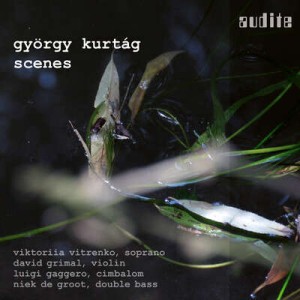
No sheet music files available for this piece.