Recollections of the teaching of György Kurtág
How did you come into contact with György Kurtág? When did you work together, when did he teach you? What was the institutional framework for your encounter?
I graduated in the Swiss Opera Studio in 2024. I wanted to take a work in Hungarian language to my closing concert there, therefore I learned Kurtág’s Attila József Fragments. As it had become my custom during the past years, I was drawing illustrations for the songs while learning them. I grew to really like the piece. After a prolonged hesitation I asked for an appointment with Kurtág to show it to him and to work on it together. We had six sessions to work on the Fragments, then we moved on to the Eszká-emlékzaj (S. K. — Remembrance Noise: 7 Songs on poems by Dezső Tandori), and we are now to continue with Schubert’s songs.
What does György Kurtág’s art and teaching mean to you and how has it influenced your career?
For Kurtág all notes are important, and the very best version of each note must be found. Sometimes you might need to work for half an hour to practice a single word in order to later vocalize it in the simplest possible form. It’s not a method he’s teaching you, rather he expects you to have a firm intention behind each and every word, and often times he will lead you there by unexpected metaphors, images, anecdotes or literary examples. On one occasion we were practicing how to utter the little word “no”. We were working on the 16th song of the Fragments (No! No! I ought to cry). Having finished the session, while we were just having a conversation, I answered a question by saying “no”, and Kurtág instantly replied “Now, this one was good!” and then added “Don’t practice it anymore.” After our meetings I always felt that every part of me had been stirred and dismantled, still I was glad to return to him more and more each time. On the one hand he attacks my mistakes severely, on the other hand he’s constantly urging me to play and he’s appreciative of my initiatives. He is strict but also very kind.
If you can, please recall a memorable situation and how he taught certain musical works and what you learned from him during your collaboration!
It was a huge help to learn the Eszká-emlékzaj with Kurtág, because I had the opportunity to learn about many of his underlying ideas right at the very beginning of memorizing the song. For example, that this 7 movement piece is actually made up of 6 recitativos and one aria. He also revealed about the Road to Damascus that he meant to reference the Lohengrin – Prelude with the open fifths.
I have also learned that he imagined the song The Sadness of the Bare Copula as a sad one:
– Why is it sadder that it became so in the last line? That’s rather hopeful, isn’t it?
– Again, the title is eloquent here. When desires are fulfilled, that’s not necessarily joyful.
I asked him if Eszká-emlékzaj was ever performed in Germain or in English, and he replied “No, it was a mistake on my part to have it translated.”
Do you have a characteristic, memorable, instructive or funny story about your joint work that you would like to share?
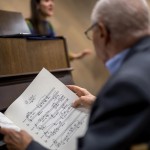
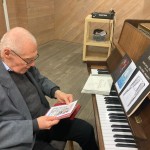
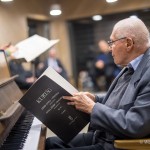
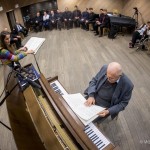
The first meeting was pretty scary: I didn’t even get a single smile at the introduction, only an F sharp on the piano. That’s where I had to start singing the 20 minutes piece — right in the investigative gaze of a professional camera, a microphone and a world renowned composer.
When I finished he told me my main mistakes: bad dynamics, wrong interpretation of short and long notes and the limits of my vocal capacity. He didn’t say anything encouraging at first — unless this “Well then, let us begin.” When the session was over, though, he asked me if I could perhaps return that evening as well, that’s what made me feel that our collaboration might continue.
I was hesitant to show him my drawings because I was afraid that he might take me for an attention-seeking teenager, but he had the opposite reaction. He inspected them with utmost seriousness, had a good long look at them and then at the next session, he held my singing to account for some of the subjects that he recognized on the illustrations.