Subtitle: Fragments of diary entries and letters of Franz Kafka, selected by the composer, for soprano and violin, in German
Dedication: Marianne Stein
Commissioner: Wittener Tage für neue Kammermusik
Premiere location: Witten
Premiere date: 1987.04.25.
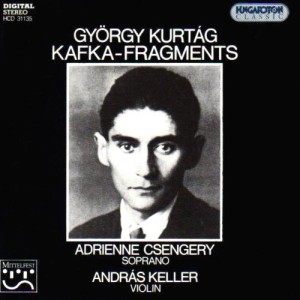
Premiere performers: Adrienne Csengery (soprano); András Keller (violin)
Lyricist name: Franz Kafka
Language: German
Composition end date: 1987.13.08
Genre: Chamber Music with Voice
Instrumentation: soprano, violin
Duration (minutes): 70
Year of publication: 1992
Publisher: Editio Musica Budapest
Publication number: Z. 13505 – ISMN: M-080-13505-1
I. TEIL
1 Die Guten gehen im gleichen Schritt…
2 Wie ein Weg im Herbst
3 Verstecke
4 Ruhelos (Berceuse I) – „VII. 6-ról”
5 Berceuse II
6 Nimmermehr (Excommunicatio) – „A Keller–Csengery párosnak”
7 “Wenn er mich immer frägt”
8 Es zupfte mich jemand am Kleid
9 Die Weißnäherinnen
10 Szene am Bahnhof – „Geszler Máriáé, aki ezt megélte”
11 Sonntag, den 19. Juli 1910 (Berceuse II) (Hommage à Jeney)
12 Meine Ohrmuschel…
13 Einmal brach ich mir das Bein (Chassidischer Tanz)
14 Umpanzert
15 Zwei Spazerstöcke (Authentisch-plagal)
16 Keine Rückkehr
17 Stolz (1910/ 15. November, zehn Uhr) – „Ígéret Kocsis Zolinak: lesz zongoraverseny”
18 Träumend hing die Blume (Hommage à Schumann)
19 Nichts dergleichen
II. TEIL
(20) Der wahre Weg (Hommage-message à Pierre Boulez)
III. TEIL
(21) 1 Haben? Sein?
(22) 2 Der Coitus als Bestrafung (Canticulum Mariæ Magdalenæ)
(23) 3 Meine Festung
(24) 4 Schmutzig bin ich, Milena…
(25) 5 Elendes Leben (Double)
(26 6 Der begrenzte Kreis – „Szűts Péteré”
(27) 7 Ziel, Weg, Zögern – „Mártáé”
(28) 8 So fest
(29) 9 Verstecke (Double)
(30) 10 Penetrant Jüdisch – „Ének Juditnak”
(31) 11 Staunnend sahen wir das grosse Pferd – „Ének Juditnak”
(32) 12 Szene in der Elektrischen “1910: ‘Ich bat die Tänzerin Eduardowa, sie möchte doch den Csárdás noch einmal tanzen…’ (Franz Kafka)” [„1910: Kértem álmomban Eduardovát, a táncosnőt, járná el mégegyszer a csárdást”]
IV. TEIL
(33) 1 Zu spät (22. Oktober 1913) (Hommage à Krapp) – „Prófécia Krappról”
(34) 2 Eine lange Geschichte
(35) 3 In memoriam Robert Klein
(36) 4 Aus einem alten Notizbuch
(37) 5 Leoparden
(38) 6 In memoriam Joannis Pilinszky
(39) 7 Wiederum, wiederum
(40) 8 Es blendete uns die Mondnacht… – „…a porban kúszó kígyó-páros: Márta és én”
______
PART I
1 The Good March in Step…
2 Like a Pathway in Autumn
3 Hiding-places
4 Restless] (Berceuse I) – "from 6 July"
5 Berceuse II
6 Nevermore] (Excommunicatio) – "To the Keller–Csengery duo
7 “But he just won't stop asking me.”
8 Someone tugged at my clothes
9 The seamstress
10 Scene at the station – "For Mária Geszler who went through this in reality"
11 Sunday, 19 July 1910 (Berceuse II, Hommage à Jeney)
12 My ear…
13 Once I broke my leg (Chassidic dance)
14 Enarmoured
15 Two walking-sticks (Authentic–plagal)
16 No going back
17 Pride (15 November 1910, 10 o'clock) – "Promise to Zoltán Kocsis: there will be a piano concerto"
18 The flower hung dreamily (Hommage à Schumann)
19 Nothing of the kind
PART II
(20) The true path (Hommage-message à Pierre Boulez)
PART III
(21) 1 To have? To be?
(22) 2 Coitus as punishment (Canticulum Mariæ Magdalenæ)
(23) 3 My fortress
(24) 4 I am dirty, Milena…
(25) 5 Miserable life (Double)
(26) 6 The closed circle – "For Péter Szűcs"
(27) 7 Destination, path, hesitation – "For Márta"
(28) 8 As tightly
(29) 9 Hiding-places (Double)
(30) 10 Offensively Jewish – "Song for Judit"
(31) 11 Amazed, we saw the great horse – Song for Judit
(32) 12 Scene on a tram – “1910: In a dream I asked the dancer Eduardowa if she would kindly dance the csárdás once more.”
PART IV
(33) 1 Too late (22 October 1913)] (Hommage à Krapp) – "Foretelling Krapp"
(34) 2 A long story
(35) 3 In memoriam Robert Klein
(36) 4 From an old notebook
(37) 5 Leopards
(38) 6 In memoriam Joannis Pilinszky
(39) 7 Again, again
(40) 8 The moonlit night dazzled us – "…the snake-couple crawling in the dust: Márta and me"
(For the English translation scroll below.)
I. TEIL
1 Die Guten gehen im gleichen Schritt…
Die Guten gehn im gleichen Schritt. Ohne von ihnen zu wissen, tanzen die andern um sie die Tänze der Zeit.
2 Wie ein Weg im Herbst
Wie ein Weg im Herbst: kaum ist er reingekehrt. Bedeckt er sich wieder mit den trockenen Blättern.
3 Verstecke
Verstecke sind unzählige, Rettung nur eine, aber Möglichkeiten der Rettung wieder so viele wie Verstecke.
4 Ruhelos
Ruhelos...
5 Berceuse II
Schlage deinen Mantel, hoher Traum, um das Kind.
6 Nimmermehr (Excommunicatio)
Nimmermehr, nimmermehr kehrst du wieder in die Städte, nimmermehr tönt die grosse Glocke über dir.
7 “Wenn er mich immer frägt”
„Wenn er mich immer frägt.“ Das „ä“, losgelöst vom Satz, flog dahin wie ein Ball auf der Wiese.
8 Es zupfte mich jemand am Kleid
Es zupfte mich jemand am Kleid, aber ich schüttelte ihn ab.
9 Die Weißnäherinnen
Die Weissnäherinnen in den Regengüssen.
10 Szene am Bahnhof
Die Zuschauer erstarren, wenn der Zug vorbeifährt.
11 Sonntag, den 19. Juli 1910
Geschlafen, aufgewacht, geschlafen, aufgewacht, elendes Leben.
12 Meine Ohrmuschel…
Meine Ohrmuschel fühlte sich frisch, rauh, kühl, saftig an wie ein Blatt.
13 Einmal brach ich mir das Bein
Einmal brach ich mir das Bein: es war das schönste Erlebnis meines Lebens.
14 Umpanzert
Einen Augenblick lang fühlte ich mich umpanzert.
15 Zwei Spazerstöcke
Auf Balzacs Spazierstockgriff: Ich breche alle Hindernisse. Auf meinem: Mich brechen alle Hindernisse. Gemeinsam ist das „alle“.
16 Keine Rückkehr
Von einem gewissen Punkt an gibt es keine Rückkehr mehr. Dieser Punkt ist zu erreichen.
17 Stolz (1910/15. November, zehn Uhr)
Ich werde mich nicht müde werden lassen. Ich werde in meine Novelle hineinspringen und wenn es mir das Gesicht zerschneiden sollte.
18 Träumend hing die Blume
Träumend hing die Blume am hohen Stengel. Abenddämmerung umzog sie.
19 Nichts dergleichen
Nichts dergleichen, nichts dergleichen.
II. TEIL
(20) Der wahre Weg
Der wahre Weg geht über ein Seil, das nicht in der Höhe gespannt ist, sondern knapp über den Boden. Es scheint mehr bestimmt, stolpern zu machen, als begangen zu werden.
III.TEIL
(21) 1 Haben? Sein?
Es gibt kein Haben, nur ein Sein, nur ein nach letztem Atem, nach Ersticken verlangendes Sein.
(22) 2 Der Coitus als Bestrafung (Canticulum Mariæ Magdalenæ)
Der Coitus als Bestrafung des Glückes des Beisammenseins.
(23) 3 Meine Festung
Meine Gefängniszelle – meine Festung.
(24) 4 Schmutzig bin ich, Milena …
Schmutzig bin ich, Milena, endlos schmutzig, darum mache ich ein solches Geschrei mit der Reinheit Niemand singt so rein als die, welche in der tiefsten Hölle sind; was wir für den Gesang der Engel halten, ist ihr Gesang.
(25) 5 Elendes Leben
Geschlafen, aufgewacht, geschlafen, aufgewacht, elendes Leben.
(26) 6 Der begrenzte Kreis
Der begrenzte Kreis ist rein.
(27) 7 Ziel, Weg, Zögern
Es gibt ein Ziel, aber keinen Weg; was wir Weg nennen, ist Zögern.
(28) 8 So fest
So fest wie die Hand den Stein hält. Sie hält ihn aber fest, nur um ihn desto weiter zu verwerfen.
Aber auch in jene Weite führt der Weg.
(29) 9 Verstecke
Verstecke sind unzählige, Rettung nur eine, aber Möglichkeiten der Rettung wieder so viele wie Verstecke.
(30) 10 Penetrant Jüdisch
Im Kampf zwischen dir und der Welt sekundiere der Welt.
(31) 11 Staunnend sahen wir das grosse Pferd
Staunend sahen wir das grosse Pferd. Es durchbrach das Dach unserer Stube. Der bewölkte Himmel zog sich schwach entlang des gewaltigen Umrisses, und rauschend flog die Mähne im Wind.
(32) 12 Szene in der Elektrischen
Die Tänzerin Eduardowa, eine Liebhaberin der Musik, fährt wie überall so auch in der Elektrischen in Begleitung zweier Violinisten, die sie häufig spielen lässt. Denn es besteht kein Verbot, warum in der Elektrischen nicht gespielt werden dürfte, wenn das Spiel gut, den Mitfahrenden angenehm ist und nichts kostet, das heisst, wenn nachher nicht eingesammelt wird. Es ist allerdings im Anfang ein wenig überraschend, und ein Weilchen lang findet jeder, es sei unpassend. Aber bei voller Fahrt, starkem Luftzug und stiller Gasse klingt es hübsch.
IV. TEIL
(33) 1 Zu spät (22. Oktober 1913)
Zu spät. Die Süssigkeit der Trauer und der Liebe. Von ihr angelächelt werden im Boot. Des wer das Allerschönste. Immer nur das Verlangen, zu sterben und das Sich-noch-Halten, das allein ist Liebe.
(34) 2 Eine lange Geschichte
Ich sehe einem Mädchen in die Augen, und es war eine sehr lange Liebesgeschichte mit Donner und Küssen und Blitz. Ich lebe rasch.
(35) 3 In memoriam Robert Klein
Noch spielen die Jagdhunde im Hof, aber das Wild entgeht ihnen nicht, so sehr es jetzt schon durch die Wälder jagt.
(36) 4 Aus einem alten Notizbuch
Jetzt am Abend, nachdem ich von sechs Uhr früh an gelernt habe, ich, wie meine linke Hand die Rechte schon ein Weilchen lang aus Mitleid bei den Fingern umfasst hielt.
(37) 5 Leoparden
Leoparden brechen in den Tempel ein und saufen die Opferkrüge leer: das wiederholt sich immer wieder schliesslich kann man es vorausberechnen, und es wird ein Teil der Zeremonie.
(38) 6 In memoriam Joannis Pilinszky
Ich kann ... nicht eigentlich erzählen, ja fast nicht einmal reden; wenn ich erzähle, habe ich meistens ein Gefühl, wie es kleine Kinder haben könnten, die die ersten Gehversuche machen.
(39) 7 Wiederum, wiederum
Wiederum, wiederum, weit verbannt, weit verbannt. Berge, Wüste, weites Land gilt es zu durchwandern.
(40) 8 Es blendete uns die Mondnacht…
Es blendete uns die Mondnacht. Vögel schrien von Baum zu Baum. In den Feldern sauste es.
Wir krochen durch den Staub, ein Schlangenpaar.
_______
PART I
1 The good march in step...
The good march in step. Unaware of them, the others dance around them the dances of time.
2 Like a pathway in autumn
Like a pathway in autumn: hardly has it been swept clean, when it is covered again with dry leaves.
3 Hiding places
There are countless hiding places, but only one salvation, but then again, there are as many paths to salvation as there are hiding places.
4 Restless
Restless...
5 Berceuse I
Wrap your overcoat, O lofty dream, around the child.
6 Nevermore (Excommunicatio)
Nevermore, nevermore, will you return to the cities, nevermore will the great bell resound above you.
7 "But he just won't stop asking me"
But he just won't stop asking me. That 'ah', detached from the sentence, flew away like a ball across the meadow.
8 Someone tugged at my clothes
Someone tugged at my clothes, but I shrugged him off.
9 The seamstresses
The seamstresses in the downpours.
10 Scene at the Station
The onlookers freeze as the train goes past.
11 Sunday, 19 July 1910
Geschlafen, aufgewacht, geschlafen, aufgewacht, miserable life.
12 My ear...
My ear felt fresh to the touch, rough,
cool, juicy, like a leaf.
13 Once I broke my leg
Once I broke my leg: it was the most wonderful experience of my life.
14 Enarmoured
For a moment I felt enarmoured.
15 Two walking-sticks
On the stock of Balzac's walking-stick: 'I surmount all obstacles'. On mine: 'All obstacles surmount me'. They have that 'all' in common.
16 No going back
From a certain point on, there is no going back. That is the point to reach.
17 Pride: 15 November 1910, 10 o'clock
I will not let myself get tired. I will dive into my story even if that should lacerate my face.
18 The flower hung dreamily
The flower hung dreamily on its tall stem. Dusk enveloped it.
19 Nothing of the kind
Nothing of the kind, nothing of the kind.
PART II
(20) The true path
The true path goes by way of a rope that is suspended not high up, but rather just above the ground. Its purpose seems to be more to make one stumble than to be walked on.
PART III
(21) 1 To have? To be?
There is no 'to have', only a 'to be', a 'to be' longing for the last breath, for suffocation.
(22) 2 Coitus as punishment (Canticulum Mariae Magdalenae)
Coitus as punishment for the happiness of being together.
(23) 3 My fortress
My prison-cell – my fortress.
(24) 4 I am dirty, Milena...
I am dirty, Milena, endlessly dirty, that is why I make such a fuss about cleanliness. None sings as purely as those in deepest hell; it is their singing that we take for the singing of angels.
(25) 5 Miserable life
Slept, woke, slept, woke, miserable life.
(26) 6 The closed circle
The closed circle is pure.
(27) 7 Destination, path, hesitation
There is a destination, but no path to it; what we call a path is hesitation.
(28) 8 As tightly
As tightly as the hand holds the stone. It holds it so tight only to cast it as far off as it can. Yet
even that distance the path will reach.
(29) 9 Hiding places
There are countless hiding places, but only one salvation; but then again, there are as many
paths to salvation as there are hiding places.
(30) 10 Overpoweringly Jewish
In the struggle between yourself and the world, side with the world.
(31) 11 Amazed, we saw the great horse
Amazed, we saw the great horse. It broke through the ceiling of our room. The cloudy sky scudded weakly along its mighty silhouette as its mane streamed in the wind.
(32) 12 Scene on a tram (1910: 'In a dream I asked the dancer Eduardowa if she
would kindly dance the Csárdás once more ... ')
The dancer Eduardowa, a music lover, travels everywhere, even on the tram, in the company of two violinists whom she frequently calls upon to play. For there is no ban on playing on the tram,
provided the playing is good, it is pleasing to the other passengers, and it is free of charge, that is to say, the hat is not passed round afterwards. However, it is initially somewhat surprising and for a little while everyone considers it unseemly. But at full speed, with a powerful current of air, and in a quiet street, it sounds nice.
PART IV
(33) 1 Too late (22 October 1913)
Too late. The sweetness of sorrow and of love. To be smiled at by her in a rowing boat. That was the most wonderful of all. Always just the yearning to die and the surviving, that alone is love.
(34) 2 A long story
I look a girl in the eye, and it was a very long love story with thunder and kisses and lighting. I live fast.
(35) 3 In memoriam Robert Klein
Though the hounds are still in the courtyard, the game will not escape no matter how they race through the woods.
(36) 4 From an old notebook
Now, in the evening, having studied since six in the morning, I noticed that my left hand
has for some time been gripping the fingers of my right in commiseration.
(37) 5 Leopards
Leopards break into the temple and drink the sacrificial jugs dry; this is repeated, again and again, until it is possible to calculate in advance when they will come, and it becomes part of the ceremony.
(38) 6 In memoriam Joannis Pilinszky
I can't actually ... tell a story, in fact I am almost unable even to speak; when I try to tell it, I usually feel the way small children might when they try to take their first steps.
(39) 7 Again, again
Again, again, exiled far away, exiled far away. Mountains, desert, a vast country to
be wandered through.
(40) 8 The moonlit night dazzled us
The moonlit night dazzled us. Birds shrieked in the trees. There was a rush of wind in the fields.
We crawled through the dust, a pair of snakes.
(Translated by Julia and Peter Sherwood)
In December 2001, aesthetician Péter Balassa published an essay titled “Kurtág, the Reader” in the literary weekly Élet és Irodalom, in which he wrote the following: “György Kurtág’s choice of texts contradicts the traditional view that a significant composer selects literary texts of merely modest, or even insignificant, quality for his compositions. In his case, by contrast, the challenge is striking, since he selects – overwhelmingly – from great writers, even authors of almost excessive stature, choosing lines, poems, and short prose pieces that reveal the essence of things and carry great weight. He is a selective reader. He flips through pages, picks and chooses, cuts them in half, snips them, and stitches them together (see also “techné”, among other things). It’s as if this resolve and this way of reading were saying: let’s see, great literature, what we can do together. For him, the encounter between text and music is a genuine drama – a professional, masterful clash between the artistic and poetic spheres, whether the piece is lyrical, painfully gentle, convulsively exciting, or puritanical.”
There is scarcely a more powerful example of the dramatic encounter between great literature and music than Kafka Fragments (Op. 24), composed in 1985–1986 and widely regarded as Kurtág’s magnum opus – the most frequently performed and most often recorded work in his oeuvre. Kafka Fragments became a defining work not only for musicians and audiences, but was also regarded by Kurtág himself as a key piece even at the time of its creation. This is evidenced by the dedication, which is addressed to art psychologist Marianne Stein.
Following the 1956 revolution, Kurtág moved to Paris in early 1957 with the intention of emigrating. Since his wife and young son were unable to obtain passports, he ultimately returned home in 1958, after spending a year in the French capital. He recalled this period as follows: “In 1956, my world collapsed – not only my external world, but my internal world as well; my entire way of being was called into question. I sank to a terrible depth. […] I was only ever able to compose when I was at peace with myself, when I could accept myself as I am – when I found some kind of unity in my worldview. … In Paris, I felt, to the point of despair, that nothing in the world was true and that I had no foothold in reality.” Therapy sessions led by art psychologist Marianne Stein pulled him out of that low point, and from her he received the lifelong advice to focus on individual notes when composing: “She told me to place two notes side by side and create a melodic unit from them, which I took to mean that I should write a piece beginning with a single note – say, a C,” he recalled in a 2023 interview with The Guardian. As a result of his intensive work with Marianne Stein, Kurtág resumed his compositional career upon returning home with his String Quartet, Op. 1, which he also dedicated to her.
By the time he began writing the Kafka Fragments in 1985, Kurtág already had numerous vocal compositions to his credit: the large-scale Sayings of Péter Bornemisza (Op. 7), the Pilinszky and Tandori songs, and a series of vocal works in Russian. This was also not the first time he had set poetic fragments to music; a few years earlier, he had composed the Attila József Fragments, Op. 20, for unaccompanied solo soprano. However, few of his works offer a better example of how to create a composition by juxtaposing two notes than the opening movement of the Kafka Fragments. “The good march in step. Unaware of them, the others dance around them the dances of time.” – so reads the text, while the violin stubbornly repeats two notes (C and D), and the vocal part sometimes moves in unison with it, sometimes slips out of step, and sometimes breaks into a vocal dance.
Kurtág selected the texts from Franz Kafka’s diaries, notes, letters, and other writings. This process began during his stay in Paris, when he came to know Kafka more deeply. The compositional work, however, did not begin until the summer of 1985, when Kurtág was in Szombathely working on the piano concerto intended for Zoltán Kocsis – a piece that remains unfinished to this day. The composition progressed with extraordinary intensity, but Kurtág could not decide on the sequence of the forty short movements that had been completed by the second half of 1986. The work, as we know it today, finally took its definitive form through the collaboration of musicologist András Wilheim. Although it was suggested at the time that Kafka Fragments could be regarded as a kind of “open work” – that is, that freely combinable cycles could be formed from it – following the world premiere by Adrienne Csengery and András Keller in Germany in 1987, and especially since the publication of the score in 1992, the piece has been established in its four-part form, a form that has been widely performed, recorded, and continues to be performed today.
The fragmentary nature, of course, gives the work a character quite different from that of a traditional song cycle, since no story unfolds here – not even in outline – as in Schubert’s Die schöne Müllerin or Schumann’s Dichterliebe. In his book on German Romantic song literature, Kilian Spau writes: “The fragments do not fit together like the pieces of a jigsaw puzzle, which are meant to form a seamless, coherent whole; rather, they stand alongside one another like stars. It is up to the observer to assemble from them a constellation in which the fixed, immovable positions of the individual elements appear as chosen details of a higher-order, internally coherent structure.”
The first part of Kafka Fragments consists of 19 very short movements, while the second part – the “heart” of the work – consists of a single movement, the longest in the piece, which Kurtág dedicated to Pierre Boulez and which can also be regarded as the ars poetica of his entire compositional career: “The true path goes by way of a rope that is suspended not high up, but rather just above the ground. Its purpose seems to be more to make one stumble than to be walked on.” The third part consists of 12 movements, and the final part consists of 8 movements. Recurring themes in the selected Kafka texts include wandering; the relationship between beauty and ugliness; the relationship between purity and sin; the search for the boundaries of personality and the possibilities of expression; and the desire to accept the aimlessness of existence. Václav Havel called the piece a “true Central European encyclopedia,” and the music is equally encyclopedic in scope: no vocal technique or violin-playing style is absent from its movements. The violin sometimes accompanies, sometimes illustrates, and at other times sings or comments, while – together with the vocal part – it strives with every fiber of its being, with extraordinary intensity and patience, to achieve a deeper understanding of the text.
At the end of his previously cited essay, Péter Balassa writes, “If I am not mistaken, Kurtág is among those who read slowly. All of this, of course, belongs to the realm of inner discipline, which ultimately remains – always – the secret of the true creator, in this case his own living secret, one that is sometimes not meant to become conscious. György Kurtág, the true composer, is also a superb reader and literary scholar – that is, more or less, all that concerns us. In any case, Franz Kafka (allegedly) said during one of his slow walks through Prague with Gustav Janouch that there is only one virtue that encompasses all the others: patience, which perhaps means nothing more than a lifetime of attentive listening, and nothing else.”
(Gergely Fazekas)
No sheet music files available for this piece.
Review by Paul Griffiths
(The New Hungarian Quarterly, 1988)
[…] As if to demonstrate the difference between competence and searing necessity, the evening after the Durkó–Kalmár–Szőllősy concert was devoted to the first Hungarian performance of György Kurtág’s Kafka-Fragmente (1985–7), setting extracts, sometimes only brief phrases, from the Prague writer’s letters and diaries to make a seventy-minute unbroken cycle for soprano and violin. The nearest comparable work would perhaps be Janáček’s From the House of the Dead: there is the same exact pinpointing of expressionist gesture, the same curious ability to elate and drain the listener at the same time. The essential difference in tone is that Kurtág’s work, so closely following Kafka in this, blends bleak self-disclosure and ironic self-mockery into a tight unity. A few of the thirty-nine numbers might appear to have a single expressive character – comic, erotic, furious, nostalgic – but generally the effect is not at all so easy to define, while at the same time the music, like so much of Kurtág’s work, always sounds precisely and even violently right, as if the notes have to be this way and no other.
To convey such an impression, of course, required long and intense rehearsals involving the composer and his chosen performers. Adrienne Csengery, for whom most of his recent music has been written, gave a performance of quite unquestionable authority, throwing her voice with apparent ease around a space of almost three octaves, insinuating a wide variety of tone colour into her singing, making everything spring from the uttering of the text. The work is so much hers that it would almost have to be rewritten for another singer. Inevitably the violin part is less personal, but András Keller’s brilliance, fineness and highly-strung energy were valuable in exposing music that shadows, supports, illustrates and sometimes takes over the expressive force driven into the soprano line.
The work is, indeed, a real duo and not a set of songs with accompaniment, just as it is a real cycle and not merely a sequence. Many of the numbers are of Webernian brevity (though Webern was never so weird or so funny); others are much longer, including the adagio that is a monitory “hommage-message” addressed to Pierre Boulez on the difficulties of “the true path”, or the teasing anecdote about the dancer Eduardowa and her two violinists riding the tram. All the songs, though, have their identities intensified by their placing in the whole. This is Kurtág’s longest work so far, and its ability to establish and sustain such a rich and individual world of lyrical despair leaves one waiting with a daring hope for his promised theatre work on Hölderlin. […]
(The New Hungarian Quarterly 29 [1988]/109, 226–227.)
No sheet music files available for this piece.