Dedication: Movement 2: Lajos Bárdos; Movement 3: Katalin Szegő; Movement 4: "For Gyuri" (György Kurtág Jr.)
Premiere location: Budapest
Premiere date: 1975.10.01.
Premiere performers: István Gáti (bass); Budapest Chamber Ensemble, conducted by András Mihály
Hungarian premiere location: Budapest
Lyricist name: János Pilinszky
Language: Hungarian
Composition end date: 1977
Genre: Chamber Music with Voice
Instrumentation: baritone / bass, clarinet, horn, cimbalom, Bozay-zither / viola da gamba / double bass, violin, viola, violoncello
Duration (minutes): 8
Year of publication: 1979
Publisher: Universal Edition/Editio Musica Budapest
Publication number: UE 16841
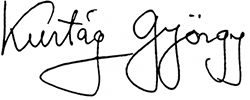
1 Alcohol
2 In memoriam F. M. Dostoevsky
3 Hölderlin
4 Beating
1. Alcohol
I conjure up the impossible,
a house stands on it and a bush,
a silent, silent creature and a
trouser leg in falling darkness.
2. In memoriam F. M. Dostoevsky
Bend down. (Bends to the ground.)
Stand erect. (Rises slowly up.)
Take off your shirt and underpants
(Takes them off one by one.)
Turn and face me
(Turns away. Faces him.)
Put on your clothes.
(Puts them back on.)
3. Hölderlin
December's fervour, summer's flailing hailstorm
wild bird encumbered with clogs
this and more I've been. Willingly I die.
4. Beating
Now I can endure it.
Now other thoughts occur.
Now noting is
Now I exist.
Now everything.
Now more than one can suffer.
Now finally, now in loneliness,
now in ultimate, utter loneliness,
just you and I.
Translated by T. László András
Kurtág described his first meeting with János Pilinszky (1921–1981) in a 2022 interview: “One night after a concert, a few of us were standing at the tram stop. After a short wait, a maintenance car arrived with the inscription “Síncsiszoló” (“track grinder”). We joked about what a great little composition a “Sín-csi szóló” would make [Shin chi solo – Shin chi being an imaginary Chinese instrument], at which point someone in the background laughed – it was Pilinszky. Later, while enjoying some good pálinka and already a bit tipsy, our collaborative work, “Alkohol”, was born – a piece that, of course, has nothing to do with the drink itself.” The meeting likely took place in the late 1960s.
Following the premiere of The Sayings of Péter Bornemisza in Darmstadt and Budapest, György Kurtág was regarded in the Hungarian music scene as the most significant composer of his generation. Although Pilinszky was only five years older than Kurtág, his first collection of poems, Trapéz és korlát (Trapeze and Parallel Bars), published in 1946 when he was just 25, caused a stir, and communist cultural policy found it difficult to deal with the fact that Pilinszky was both a staunch anti-fascist and a deeply devout Catholic. His second collection, Harmadnapon (On the Third Day), was not published until 1959, and the next, Nagyvárosi ikonok (Metropolitan Icons), did not appear until 1970. This volume contained only twelve new poems. Literary historians regard Szálkák (Splinters), published in 1972, as the first examples of Pilinszky’s late poetry. These short, unrhymed poems, which break from his earlier strophic structure, appear in surprisingly large numbers compared to the output of his previous volumes—a total of 58 poems are included in the collection. This was followed by only two slim volumes: Végkifejlet (Dénoument) in 1974 and Kráter (Crater) in 1976.
If we look for traces of Pilinszky in Kurtág’s oeuvre, the first thing we find is the cimbalom piece Splinters, composed in October 1973. The poet himself attended the world premiere on October 2, 1974 and cimbalom player Márta Fábián, the work’s dedicatee and premiere performer, told the daily Népszava on December 25 the following: “I am very happy that György Kurtág composed Szálkák for me, and that János Pilinszky, the author of the poetry volume associated with the work, was also very pleased with my performance.”
While composing Splinters, Kurtág began to focus on setting Pilinszky’s poems to music. He first wrote the song “Alcohol” in July 1973; a little over a year later, on September 7, 1974, he completed “In memoriam F. M. Dostoevsky.” Half a year later, in January 1975, he set the poem “Hölderlin,” and finally, in September 1975, “Beating.” He then published these songs as the cycle “Four Songs on Poems by János Pilinszky,” catalogued as Op. 11.
The first two poems are from Pilinszky’s 1974 collection Dénouement, while the third and fourth are from the 1976 collection Crater – meaning that Kurtág had already been working on the songs before the poems they were based on had been published in book form. Of course, this is not surprising, since Pilinszky published his poems in various literary journals, so Kurtág could have become familiar with the texts through those publications or through manuscripts. What is surprising, however– and what highlights the deep intellectual kinship between the composer and the poet– is that, although Kurtág was unlikely to have known about it, Pilinszky planned to organize the published collection of Crater into a cycle in which “Hölderlin” and “Beating” appeared side by side, just as they do in Kurtág’s song cycle.
After setting Péter Bornemisza’s archaic text and two texts of lesser literary merit (by Pál Gulyás and István Bálint), this is the first time Kurtág has set to music the work of a contemporary or 20th-century poet whose sensitivity and linguistic artistry match the level of Kurtág’s music. And this is where we first encounter– albeit indirectly – the literary cultures that would later prove so defining for Kurtág: German and Russian, represented respectively by “Hölderlin” and “Dostoevsky.”
Perhaps even more important is the program Kurtág set for himself after his therapeutic sessions in Paris with art psychologist Marianne Stein in 1957–1958: to start from a single note and build structures from nothing, a concept taken to its extreme and first appearing in the Pilinszky songs. Few works demonstrate this more powerfully than the song “Alcohol,” which is nothing more than a recitation of a single D note.
The Pilinszky songs are thus a complex testament to the discovery of a distinctive Kurtágian style built from the basic elements of music, a new kind of connection between Kurtág and contemporary literature, and the transformation of personal experiences into music.
(Gergely Fazekas)
No sheet music files available for this piece.
Reviews of the World Premiere
Review by Péter Várnai
(Magyar Hírlap, October 8, 1975)
[…] This year’s festival included an evening dedicated to the works of György Kurtág. The Grand Hall of the Academy of Music was filled to capacity with an eager audience, which is understandable, since Kurtág is perhaps our most significant living composer. The program offered a cross-section of Kurtág’s career to date. His 1959 String Quartet (Op. 1) was still largely influenced by Webern, yet even this work differs from – and at times transcends – the music of the great Viennese master who served as its model. In the Wind Quintet, the Duo for Eight Violins and Cimbalom, Splinters, and especially in the monumental Bornemisza Concerto, Kurtág’s individuality is fully revealed. No matter what contemporary techniques he employs, his music always serves first and foremost to express emotions and passions – and always at the highest intensity. Not only in his vocal works, where the musical representation of words and phrases takes on recognizable form, but also in his instrumental pieces, every note carries its own emotional resonance. This is what allows even the briefest movements to unfold a whole world before the listener. The expressiveness and expressionist tone of the Pilinszky songs performed at the premiere also serve this purpose, ranging from declamation in a single voice to richly woven dramatic scenes. […]
The large cast in this author’s evening – which ran a bit long – interpreted the works with utmost dedication and a deep love for Kurtág, including three children who performed his short piano pieces magnificently.
(Magyar Hírlap 8 [1975]/265, 6.)
___________
Review by Márta Sz. Farkas
(Magyar Nemzet, October 4, 1975)
[…] The poetic inspiration of János Pilinszky has influenced several of György Kurtág’s works. Márta Fábián performed the poignant and profound music of Opus 6, Splinters, with such personal conviction that it confirmed the dedication of the works as fully deserved. The evening’s eagerly anticipated premiere also echoed the poetry of János Pilinszky. The composition Four Songs on Poems by János Pilinszky is György Kurtág’s latest work. It is separated from the works heard previously by nearly a decade and a half, and by an immeasurable degree of artistic maturity. The concentration of expression here seems to surpass all previous intensity; the motifs, timbres, evolving timbral combinations, rhythms, and forms appear to carry even greater meaning and significance, while every superficial element recedes further into the background. Thus, the message of the songs had a truly moving impact and convinced the audience of the merit of the unusually composed chamber ensemble accompaniment – which included two cimbaloms and two zithers – because every note and every tone has a function and a significance that conveys emotions, a state of mind, and a situation. István Gáti’s interpretation deserves sincere praise, and the accompanying chamber ensemble, whose members we do not list here solely for lack of space, likewise merits our highest commendation. The inspiring power of the music explains how this ad hoc chamber ensemble – without a conductor – adapted so perfectly to the soloist, brought the entire score to life so convincingly, and conveyed and evoked the meaning of even the smallest details. […]
(Magyar Nemzet 31 [1975]/233, 4.)
___________
Review by János Breuer
(Népszabadság, October 7, 1975)
[…] At György Kurtág’s concert – part of the “Music of Our Time” series – nearly the entire oeuvre of one of the most significant figures in contemporary Hungarian music was performed. […]
The most eagerly anticipated works on the concert program were two new pieces: the Four Pilinszky Songs and the piano cycle titled Games. The impact of these songs is staggering. The composer offers a rare glimpse into the most hidden secrets of his creative process. He expresses himself even more concisely than before, with the vocal line hovering at the boundary between rhythmic speech and melody; this precisely creates immense tension when, now and then, a broader melody breaks forth from the words. It evokes the primordial state of the relationship between song and speech. […]
(Népszabadság 33 [1975]/235, 7.)
___________
Review by András Rajk
(Népszava, October 12, 1975)
From an exceptionally rich program – which included, among other things, concert hall premieres of works by András Mihály, Endre Székely, and András Szőllősy, as well as performances of works by most major Hungarian composers – the music of our century was represented from Berg to Shostakovich and Schönberg to Stockhausen, and composers such as Krzysztof Penderecki appeared in person. From this program, we would like to highlight György Kurtág’s composer’s evening.
Kurtág is an intriguing and exciting figure of the generation – or even generations – after Bartók. His music is rooted in Bartók, though this is true of nearly every notable Hungarian composer of the second half of the century, as well as many non-Hungarians. In Kurtág’s music, there are many new elements, both in sound and in structure, not only in comparison with Bartók and his great contemporaries, but also in relation to their outstanding followers. Kurtág composes in an extremely concise, austere manner, yet his terse, eloquent message is always filled with genuine emotion, stormy passion, and, at times, serenity. […] The songs set to the poems of János Pilinszky – songs with a completely new tone – were performed with poignant simplicity by István Gáti, just as Splinters was performed by Márta Fábián, that fortunately obsessed cimbalom star of today’s music.
(Népszava 103 [1975]/240, 8.)
___________
Review by György Kroó
(Hungarian Quarterly, 1976)
The Composer’s Concert of György Kurtág (b. 1926) at the Ferenc Liszt Academy of Music in Budapest comprised a selection of pieces over sixteen years beginning from Opus 1 to the present. Lasting one hundred minutes, the concert was an infinite concentration of Kurtág’s music – white-hot from inspiration and representing about a third of his output. The two new cycles (Plays, Four Songs on János Pilinszky’s Poems), first performed here, are compositions for the piano, songs and chamber music which organically fit in with his previous work. If anything jeopardized the success of the concert, it was the recurrence of sounds and genres, which was not fully counterbalanced in depth of content. But Kurtág was not here interested in opening new directions toward the unknown. He develops as a snail builds its shell, expanding and maturing in harmony from the inside and in all directions simultaneously. […]
As works of art, the pieces for four hands are the most valuable among all his compositions, but all the miniatures of the Plays are pearls of modern music for their piano technique and stylistic studies. They are the realization of no principles but inspired self expression. There are no spasms or stutterings behind them. The composer becomes freer and freer as he flies into ever more spacious worlds in style, technique and expression. An excellent example of this upward movement is the Pilinszky song cycle.
In November 1973 Kurtág’s piece for cimbalom, Splints, indicated the poet in him. The next summer Kurtág set to music one of the works in the volume of poetry Alcohol. It was followed a year later by the music set to Pilinszky’s “In Memoriam F. M. Dostoevski”. In January last year he wrote the Hölderin-song and recently finished this cycle by composing music to the poem, Thrashing. Though perhaps not important, it is characteristic of Kurtág that the music of these four songs is also related to the Plays: Alcohol is based on a single sound like the miniatures Preludium and The Waltz from the Plays, while the ostinato of the cimbalompart of Thrashing is identical to the Three Sounds in Three Rhythms of the Plays.
In Alcohol Pilinszky’s idea is brilliantly set to music with variations of a single sound formed at the roof of mouth: it is done by pressing the throat, causing vibrations while lowering the voice. The second song grows gradually from this rhythm and develops into a dialogue, while the bass voices and violin parts, which are constructed round the recitative singing and declamation, build a brilliant musical palace… In the Hölderin score the tempo of the series accelerates and becomes a kind of folk-dance scene which runs amok and gets caught by the important question of the three-line poem: “What have I not yet been?” Finally – now accompanied by the whole chamber ensemble – comes Thrashing, towards which the whole cycle was moving, which finally completes it.
It is a fantastic work of art, growing from the initial note to an ensemble; moans change into syllables, then into words and sentences. Melodic speech becomes declamation, is then transfigured into song, as the parts coalesce together more and more closely, getting denser and denser, to a final melodic resolution: “And now, / now and alone, / here and now and / for ever / only you and me!”
This wonderful, beautiful sostenuto music is the climax of Kurtág’s oeuvre to date.
(The New Hungarian Quarterly 17 [1976]/62, 200–202. This review is the English translation of György Kroó’s piece published on October 18, 1975, in Élet és Irodalom)
___________
Review by György Kármán
(Film Színház Muzsika, October 18, 1975)
[…] We cannot turn away – among other things – from the works of György Kurtág simply because they are concise and direct. Their message and pared-down performance apparatus do not “bellow” in the negative sense of the word. They provoke thought; they ignite emotion through intellect. We came to realize that the human voice, the vox humana, spoke to us through his works, whether we were listening to individual pieces from Splinters, composed for cimbalom, or to the songs set to the poems of János Pilinszky. And did we not hear a new Psalmus Hungaricus resound once more in the words of Péter Bornemissza? […]
(Film Színház Muzsika 19 [1975]/42, 7.)
___________
Review by Sándor Tóth
(Vigília, November 1, 1975)
[…] The composer has no “sharp daggers”; he confronts the depths of the soul with his own soul, and this is harder than any blow. His effects: struggle and humility, and the opening of infinite horizons, just as in Bach. He conveys everything: a desert-like existence and infinite longing, silence and unbearable loneliness. But also the flower-like worth of humanity and the faith that “is not a dream, but a living creature that grasps God and is powerful, and, like the light of the world, shines upon others as well.”
Thus, we felt the kinship between the Four Songs based on Pilinszky’s poems and The Sayings of Péter Bornemisza. Not by chance: life, sin, death, spring – eternal poetic themes – and through them Kurtág articulates his ars poetica. And that is purity. As we read in the lines by Attila József that were chosen as the motto for the Bornemisza cycle: “…I cannot die, I must not, / until I have / found purity.” Until then? “Hero of December, summer’s hailstorm…” And forever the harsh self-examination of conscience, the dependence on ultimate matters, the terrible responsibility of talent.
György Kurtág approaches music with such humility that we can rightly say the spirit of Heinrich Schütz lives on in him. István Gáti understood Pilinszky’s poems, and Erika Sziklay gave a moving interpretation of the 16th-century preacher’s homilies. And Márta Fábián, the brilliant cimbalom player, performed a piece titled Splinters, a musical metamorphosis of Pilinszky’s poetry. It is a meeting of two artists on the threshold of the transcendent, where speech becomes nothing more than a stammer. If this “speech” in the Four Songs is the purest song of the “vox humana,” then the series of motifs, or even a single note “resonating” on the cimbalom’s strings at special moments, is meant to create space for contemplation. In Kurtág’s Splinters, there is also contemplation: spiritual substance without which no one can come to know themselves, others, or the world. In this work, silence is mandatory. […]
(Vigília 40 [1975]/11, 784–785.)
___________
Review by István Homolya
(National Philharmonic Program Booklet, November 16, 1975.)
[…] Although the recital offered only an incomplete cross-section, since five significant years were omitted from the series, it clearly outlined the fundamental trends, turning points, and changes in Kurtág’s artistic development. A clear sense of continuity is discernible from the 1959 Wind Quintet to the piano pieces of his most recent period. At the same time, the Bornemisza cycle, composed over six years, not only stands out from the rest of his oeuvre in its scope and message, but also marks a significant turning point. The works composed after 1968 convey a distinct sense of liberation and ease. This liberation is evident not so much in terms of content – though it appears there as well – but rather in a more confident command of compositional technique. The clearest outward sign of this is the growing number of works and the relative simplification of their performance requirements. This applies equally to the Pilinszky songs and to the short piano pieces collected under the title Games.
The performers made the concert truly memorable with their finest efforts. Among them, we must highlight István Gáti and the accompanying chamber ensemble (Pilinszky songs), the three young pianists (Beatrix Klukon, Edit Klukon, and Balázs Szokolay), and cimbalom player Márta Fábián. […]
(National Philharmonic Program Booklet [1975]/36, 56–57.)
___________
Review by János Kárpáti
(Muzsika, January 1976)
[…] The other Kurtág work now being presented, Four Songs based on poems by János Pilinszky, leads us into a dark, anguished, screeching, suffocating world. It is a closed cycle in which each piece represents a different mood and requires a different instrumental ensemble. What they share, however, is the poet’s and the musician’s equally sparse economy of words, the chilling silences, the ability to experience and radiate a piercing cry, and the ever-recurring confrontation with death. The first song, titled “Alcohol,” begins with an unaccompanied bass-baritone solo in the form of a recitative chant on a single pitch, which nevertheless incorporates a wide variety of timbres and vocal techniques before settling on a cadence a step lower. In the second song, “In memoriam F. M. Dostoevsky,” a single violin part accompanies the vocal line, creating a distinctive counterpoint to its harsh, menacing, clattering prose. The third and fourth songs lead into a more musical world: in the third, titled “Hölderlin,” a string trio provides the accompaniment, while in the fourth song, “Beating,” the richly textured sound of a seven-member chamber ensemble joins the vocal line. This diversity, however, remains equally ascetic and compressed into shades of black and gray as the recitative of the first song. The zither sustains a single note from beginning to end, played with a bow and evoking an effect reminiscent of the lingering accompaniment in Far Eastern music; the cimbalom adds only a few tonal hues, while the music’s basic texture consists of repeated, ostinato-like melodic fragments. Kurtág, however, does not even strive for true coloration, but instead for various shades of gray, into which a web of lines runs, somber and relentless.
Compared to Kurtág’s earlier works, these Four Songs represent a simplification. The text was also important in the Bornemisza Concerto, as well as the conceptual and intellectual ordering of the material, but the rich, multifaceted piano part accompanying the vocal line contrasts with the puritanical instrumental accompaniment of the Pilinszky songs. This applies to the vocal part itself as well: whereas in the former, wide-interval melodic leaps heightened the music’s expressiveness, here the vocal line narrows even melodically, becoming restrained, terse, and prosaic. We welcome Kurtág’s “new stylistic era” with great enthusiasm and joy, for, as always, his message is important, weighty, compelling, and overwhelming in its power; yet we are not certain whether this shift – viewed from a broader perspective – will ultimately benefit his art, or whether it is merely paving the way for yet another shift. […]
(Muzsika 19 [1976]/1, 10–11.)
No sheet music files available for this piece.